So You’re Thinking of Writing a Book?
Myke King has written a book on process control, now in its second edition, and another on statistics. Here he reflects on the long road from recognising a need to finally getting a book into readers’ hands
Quick read
- Books start with a gap: Identifying a real need in industry is what turns an idea into a viable book
- The real challenges are editorial: Copy edits, formatting and proofs can create as many problems as they solve
- The rewards are intangible: Reputation, impact and personal satisfaction outweigh financial return
THERE is certainly a demand for books covering practical chemical engineering, yet relatively few exist. Potential authors in industry can rarely dedicate the time and royalties are unlikely to justify the effort. In contrast, for academics, authoring at least one book is almost expected. Academic careers depend on published work and a book supporting lectures has a ready market among students.
So, we are spoilt for choice when it comes to theory. This is particularly true in my field of process control. A quick check of my bookshelf revealed around 40 books on the subject, of which only three were written by those working primarily in industry – and those all by the same author. Indeed it was over 30 years between me recognising the need for a book covering industrial application and actually producing one. Approaching my first book as naively as I did led to a series of highs and lows.
The pitch
One has to start with a proposal to convince a publisher it will be commercially viable. I was fortunate in that, after 30 years, I’d established enough contacts prepared to support the proposal. Indeed, many of their comments later appeared on the book’s cover and in marketing material. Writing the book itself was by far the easiest phase. I’d been presenting process control courses to industry for most of the 30 years and it was relatively straightforward to flesh these out into detailed text. Indeed, my publisher was somewhat surprised to receive the draft so quickly, apparently far more used to academics missing deadlines by months – if not years!
Figures

I’d chosen to produce all the figures to print-quality standard. Since they already existed in my training notes, it seemed easier to do this myself than proof-check someone else’s work. I delivered them as PDFs and assumed that they couldn’t be changed. Not true. Publishers have tools that can modify, for example, the text. So, I wasn’t as attentive as I should have been checking proofs and quite a few errors crept in. More on that later.
The figures were also a cause of some discussion. Many were graphs with multiple plots and distinguishing lines without colour is challenging. At the time, colour printing was seen as prohibitively expensive. With some reluctance, the publisher agreed to one additional colour (blue). Using it also for headings greatly improved the look – but delayed the electronic version;; at the time Kindle didn’t support colour. Ironically, five years later, the publisher criticised the figures in the second edition for not using enough colour.
Copy editing

Copy editing proved a nightmare. Usually freelance and appointed by the publisher, the copy editor is chosen as someone who knows at least a little about the subject. I’m guessing that such expertise in my field was difficult to find. Hundreds of non-technical alterations were made. For example, every use of “metre” had been changed to “meter”. I had to undo each one individually. Even if a global tool existed, it could not have distinguished the many cases where “meter” was correct – there are a lot of meters in process control!
Further, I’m convinced the printing industry has a surplus of commas it needs to dispose of. Like many editors, mine added them liberally – with one sentence ending up with eight. And these changes were only the tip of a very large iceberg. It was virtually impossible to pick up every change that needed reversing. It is very easy to miss an error in text that one’s already read many times.
Learning from this experience, for the second edition, the publisher reluctantly agreed the copy editor would work with MS Word, with tracking enabled. So, not only was every correction easy to spot but I could simply reject any I disagreed with.Equation numbering brought its own challenges. On a few occasions I’d given consecutive equations the same number. This was so easily done. I’d modified every chapter several times – often adding equations. While it’s easy to renumber, any reference to it and every subsequent equation has to be located in the text and changed. Chapter 12 included 133 equations with the eighth one duplicated. Correcting the problem would quite likely introduce yet more errors. Setting aside perfectionism in favour of pragmatism, the chapter now includes Equation (12.8a).
References
Publishers, particularly those focusing on academic books, like to see plenty of references. I tried to comply but including them was an eye-opener. I’m now convinced that most authors don’t check the original sources. A commonly repeated controller tuning method, Cohen-Coon, is universally written with coefficients expressed as fractions. However, the original paper shows these are approximations to numbers expressed as decimals. While not materially altering the resulting tuning, this conceals one of the underlying principles of the method. The changes made by one unknown author have propagated to every subsequent publication. The same applies to the, perhaps more well-known, Ziegler-Nichols, which was developed for disturbance rejection, not the setpoint changes commonly used to demonstrate it.
Researching my statistics book was even more challenging. Many distributions are duplicates under different names. Despite my careful checking, I too was caught out by this. An astute reader noticed that I’d described the same distribution twice, albeit under different names and using different symbols – but made more embarrassing by being consecutive sections. I ultimately avoided attribution altogether and explained why in the introduction.
The index
Indexing is tedious and time-consuming. Again, I thought it better that I did the work, rather than have to check somebody else’s. It can’t be completed until the final proof is finished. So, with only the indexing holding up publication, the indexer is under pressure to meet a deadline. The process involves compiling likely search terms, sorting them alphabetically and then locating every occurrence in the text. More mind-numbing is having to repeat the exercise for a second edition, in which the same terms will now appear on different pages. I did question whether an index was necessary. I now know it is – and frequently use mine to find material, with some satisfaction as to how effective it is.
The cover

The contract with the publisher pretty much gave them the final decision on everything. The only real disagreement was the cover. I was never entirely happy with the graphic used. We together chose bright blue for the cover of the first edition of the process control book. This proved inspired. I didn’t appreciate it until my book appeared on a shop’s bookshelf among others on the same subject. In a dull rainbow of muted browns and reds, it stood out. Indeed, if I find it in a bookshop placed in a less obvious position, I move it to be more prominent.
I wanted to keep the same colour for the second edition but was overruled by the publisher. They thought potential customers wouldn’t notice that it was a new edition. So we chose green. Ironically, prolonged sunlight fades it to blue.
Printing
Printing is often subcontracted, with costs based partly on page count. For my statistics book, the printer believed the number would far exceed that on which the quotation had been based. I was faced with the, somewhat horrifying, prospect that I might have to shorten the book. However, the printer’s prediction of the number of pages far exceeded mine. Ironically, applying the line fitting method described in the book, I was able to develop a correlation for the number of pages (n), based on the number of words (w), equations (e), figures/tables (f) and chapters (c):
n = 0.0016w + 0.2e + 0.3f + 2c + 20
It proved remarkably accurate and, much to my relief, convinced the publisher that we were within budget and avoided me having to make substantial changes. Of course, this approach made a number of sweeping assumptions – most notably about page dimensions. So, not to be used universally.
The book was printed by a different company to my others. While blue was still used for lines on graphs and section titles, it was an entirely different shade – so dark it was barely imagine I was the editor of a journal and to generate a list of questions that might be asked of me in an interview, along with the answers. These were later published as if they were genuine. It succeeded in making me sceptical of such interviews.
Errors and lessons
Those who provided supportive comments for the cover received a free copy. One engineer I’d known for many years read the book from cover to cover, pausing between every chapter to email me the mistakes he’d found. He ultimately found 48. Most of these weren’t mine, instead introduced during the editing process. Some were potentially serious such as omitting “not” in key sentences. The publisher was very good in correcting the errors for the first reprint. And a lesson learnt; the engineer finding the errors in the first edition agreed to proofread the draft of the second.
So, was it a success?
Next came the book reviews. The first to see the finished book was my mother.
Expecting her to be impressed, her sole comment was: “It’s a nice colour”. Expecting more of the reviews that appeared in places such as Amazon, I was rewarded with “I bought the book as a Christmas present for my husband”. I’m yet to discover whether he was pleased with it. The only other comment included nothing more than a moan about how the book arrived damaged.
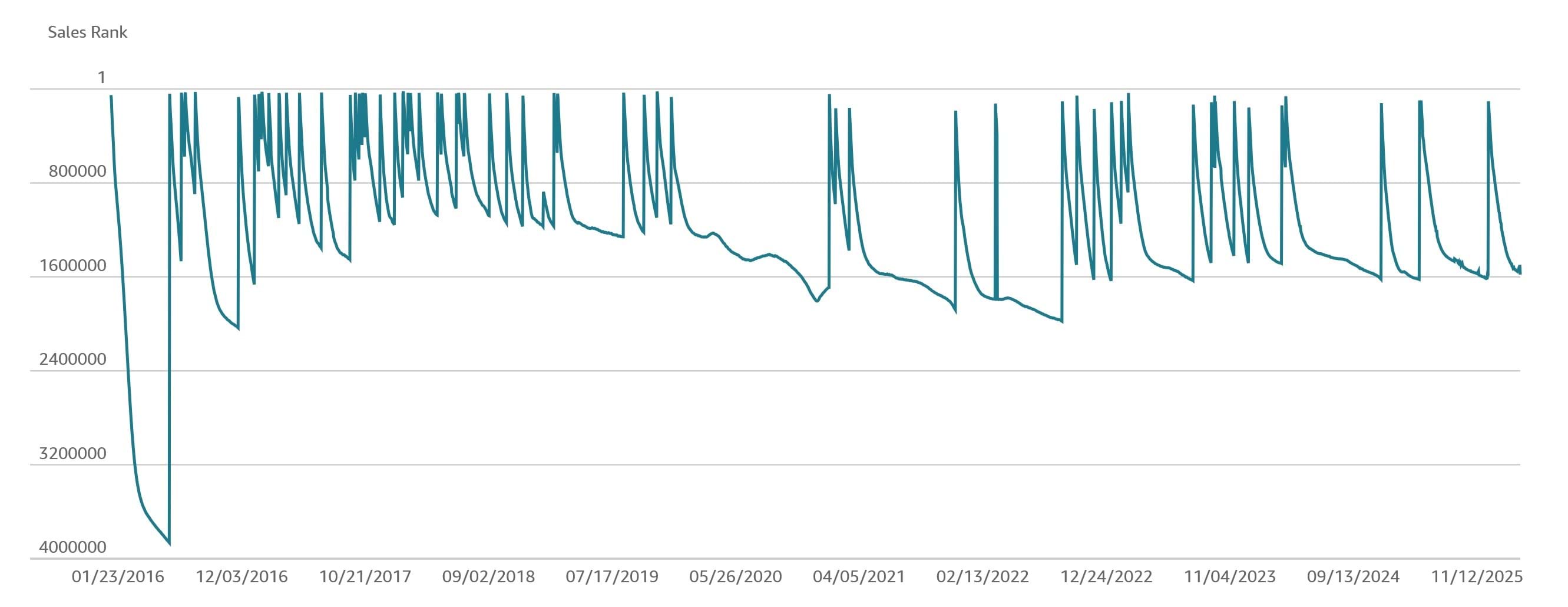
Amazon provides a service, Author Central, which includes a trend of the book’s position in the best-seller list. When I last checked, it was at position 1,595,352. Not impressive, until you realise there are over 17 million books listed – and I am competing with the likes of JK Rowling and Jamie Oliver. But it’s interesting to look at how the ranking changes over time. The ranking does occasionally jump into the top 0.5% but, while this ought to be satisfying, it takes the sale of just a single copy to achieve this.
Royalties come from multiple sources but when I calculated my effective hourly rate, it came to about £3 (US$4). When students ask if they should buy the book, I tell them the royalty roughly covers a beer – so they might as well buy me one instead.
So, was it worth it? I would hope the book helped boost my reputation. But while work comes in because clients know of me, it’s difficult to determine whether this is due to the book. It is very satisfying to be approached by someone that has bought my book and would like it signed. Well, it is, until I discover they’ve owned it for months but have clearly never opened it. But the biggest reward, I admit, is the ego boost when I hear that a section head in a manufacturing site in the US has bought a copy for each of his engineers. Or be told of a university in China that bought a copy for every student studying chemical engineering. Or someone just writing to me about saying how useful the book is. It certainly gives some impetus to write another, but enough? Maybe…
Myke King CEng FIChemE is director of Whitehouse Consulting, an independent advisor covering all aspects of process control. He is the author of “Process Control: A Practical Approach” and “Statistics for Process Control Engineers”
Recent Editions
Catch up on the latest news, views and jobs from The Chemical Engineer. Below are the four latest issues. View a wider selection of the archive from within the Magazine section of this site.