The Chartered Advantage: How Professional Registration Drives Career Success
Judith Hutchinson examines IChemE employment data showing Chartered Chemical Engineers earn significantly more, highlighting the value of professional registration and skills development
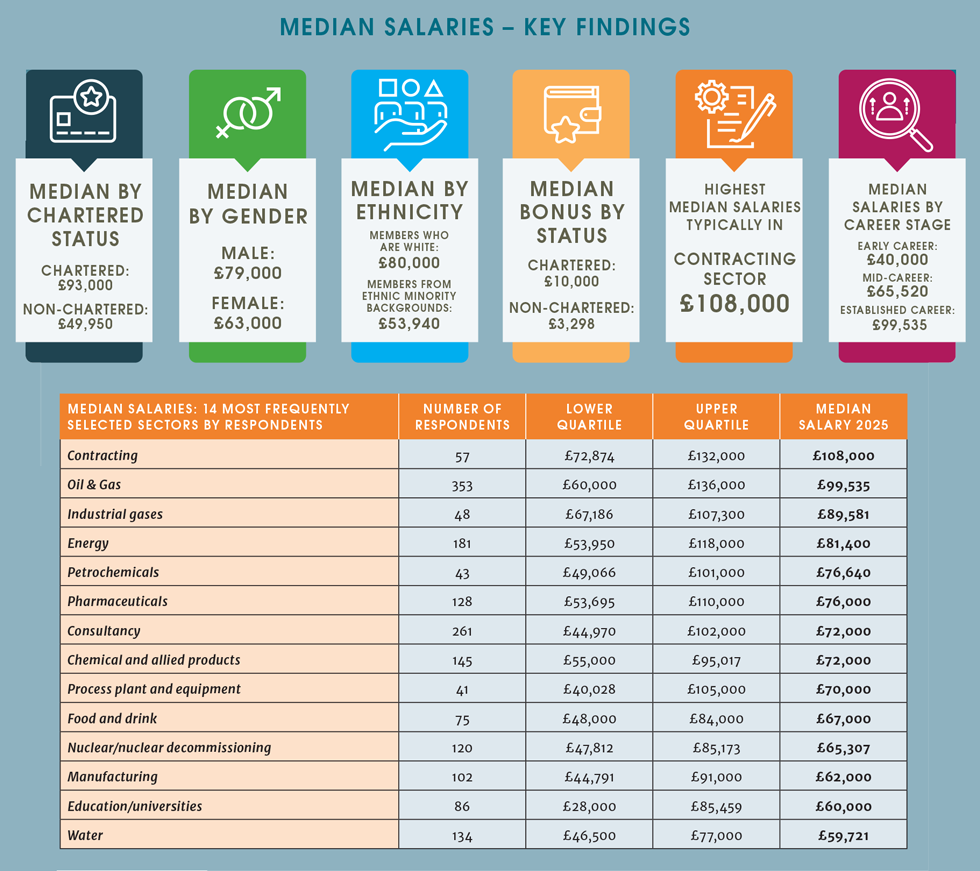
THE FINANCIAL case for professional registration has never been clearer. Chartered Chemical Engineers command a median salary of £93,000 compared to £49,950 for non-chartered members – a premium of £43,050 annually. But according to IChemE Chartered members the benefits extend far beyond compensation. As the profession navigates sustainability, transformation and talent shortages, Chartered status emerges as both a personal career accelerator and a framework for addressing industry-wide challenges.
Following last month’s coverage of mid-career shortages and skills gaps (see TCE 1,016), the full IChemE Employment Survey results – based on responses from 2,503 members and 875 employers across 114 countries – provide deeper insights into how professional registration supports career progression while helping bridge critical capability gaps.
The value proposition extends beyond monetary compensation. When asked about the impact of Chartered status, 58% of members cited increased professional credibility and recognition as the primary benefit
The career premium of chartership
The salary differential between Chartered and non-Chartered members manifests across all age groups from 25 onwards, widening as careers progress. For members aged 30–34, Chartered Chemical Engineers earn £72,000 compared to £52,000 for non-Chartered peers. By ages 45–49, this gulf widens dramatically to £110,000 versus £69,421, demonstrating that Chartered status doesn’t just provide a one-time boost but add values throughout a career.
The financial advantages extend to annual bonuses. Chartered members receive a median bonus of £10,000 compared to £3,298 for non-Chartered members. For those in established careers, bonuses represent approximately 12% of annual salary, significantly higher than the 6% typical for early-career professionals.
Yet the value proposition extends beyond monetary compensation. When asked about the impact of Chartered status, 58% of members cited increased professional credibility and recognition as the primary benefit, while 50% highlighted the sense of achievement and personal satisfaction it provided. Only 14% mentioned salary increases, suggesting Chartered professionals value the status for its broader career implications. This confidence translates into career mobility. Among members looking to change employers, those with Chartered status were significantly more likely to believe they had the necessary skills for their next move (82% versus 64%). Furthermore, 57% of Chartered members agreed that their status had contributed to career progression, with particularly strong agreement in nuclear (68%), energy (67%) and water (67%) sectors.
The mid-career talent crisis
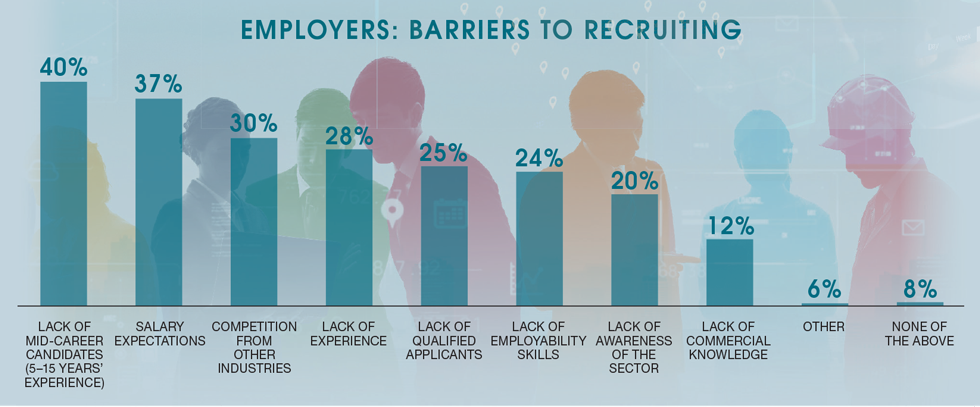
While the benefits of Chartership are evident, the profession faces a pressing challenge: a critical shortage of mid-career professionals. An overwhelming 92% of employers reported at least one significant barrier to recruiting chemical, biochemical or process engineers, with 40% specifically identifying lack of mid-career candidates as their biggest challenge.
This talent gap is particularly acute when compared to other career stages. When asked about noticeable workforce gaps, 54% of employers identified shortages at the mid-career level – far exceeding concerns about graduate (7%) or senior-level (27%) candidates. This presents a clear opportunity for the profession, employers and IChemE to better understand and address the factors driving mid-career attrition and to put measures in place to tackle them. The survey results hint at potential underlying factors: among members looking to change roles, 42% cited the desire for greater professional challenges, while 51% mentioned salary considerations. Notably, those dissatisfied with their current salary were significantly more likely to consider leaving their employer (79% versus 52% of satisfied members).
Employers in water (76%), consultancy (53%) and nuclear (52%) reported the strongest intentions to increase team sizes over the next 12 months, suggesting these sectors may be competing most aggressively for limited pools of mid-career talent.
The graduate readiness gap
While 75% of employers reported that graduates generally meet their expectations, only 12% indicated graduates meet expectations “very well”, suggesting a disconnect between academic preparation and workplace requirements.
When asked about the benefits of hiring graduates, employers most often cited strong grounding in core fundamentals and theory (33%) – long regarded as the traditional strength of degree programmes. However, this theoretical foundation does not always translate into practical capability. Employers’ top concerns included lack of drive and proactivity (23%), gaps in applied technical knowledge and skills (22%) and an absence of soft skills (20%).
Fourteen percent of employers specifically highlighted that graduates demonstrate an “overly theoretical mindset and lack of practical application”. One respondent noted: “They usually have good theory but limited practical skills and sometimes struggle with communication and problem-solving in real operational situations.”
This stands in contrast to perceptions of vocational and apprenticeship routes. When asked about their benefits, 30% of employers cited practical, hands-on experience – the capability many found lacking in graduate recruits.
As one employer put it: “Hiring through vocational or apprenticeship routes brings in candidates with strong practical skills, real workplace experience and a solid work ethic. They’re job-ready, adaptable and often more loyal, reducing training times and helping build a skilled, long-term workforce.”
Skills for a sustainable future
The profession’s transformation towards sustainability is reshaping skill requirements across all specialisms and career stages. When members were asked about the most important changes in chemical engineering, 60% identified an increasing focus on sustainability, 46% noted the adoption of digital technologies and 42% highlighted shifts in energy and industrial systems.
Among members actively planning career changes, 51% expressed interest in working in the energy sector, with 30% interested in biochemical engineering and biofuels and 28% in power generation renewables. This appetite for sustainability-focused work aligns with employer expectations: 18% anticipate growing demand for renewable and sustainability skills over the next five to ten years, making it the most frequently cited future skill requirement.
However, 40% of employers stated uncertainty about skills in greatest demand over the coming decade, making workforce planning challenging and highlighting the ongoing need for professional bodies like IChemE to provide support and guidance on emerging skills requirements.
Current skills gaps span both technical and professional capabilities. Employers identified sector-specific technical skills (45%), problem-solving and critical thinking (44%), communication skills (40%) and adaptability (38%) as the most common deficiencies. Only 3% of employers reported no skills gaps whatsoever.
Leadership emerged as the top employability skill that members themselves want to develop, with 51% identifying it as a priority for the next 12 months, followed by digital and technical skills (43%) and communication (38%). For technical skills, perhaps unsurprisingly, members showed diverse interests: risk assessment (21%), modelling and simulation (21%), sustainability (20%), process design (19%) and process safety (19%) all attracted similar attention. Importantly, 95% of early-career members indicated they needed to develop at least one technical skill, compared to 71% of those in established careers.
29% of non-Chartered members are actively preparing for Chartered status, while a further 27% are considering it for the future – signalling a substantial pipeline of professionals seeking structured progression
Professional development as the solution
The survey data suggests that professional development – and Chartered status in particular – offers a practical mechanism for addressing many of the profession’s interconnected challenges. Achieving Chartered status requires engineers to demonstrate not only technical knowledge but also the applied, professional and leadership competencies that employers most frequently identify as lacking.
This structured development pathway aligns closely with employer needs. Chartered members report higher confidence in their skills, stronger career progression and greater mobility, while employers highlight gaps in precisely the areas Chartership assesses: practical application, problem-solving, communication and leadership. In this sense, professional registration acts as both a quality benchmark and a retention tool, supporting engineers through the critical mid-career stage where shortages are most acute.
Appetite for professional registration remains strong. Currently, 29% of non-Chartered members are actively preparing for Chartered status, while a further 27% are considering it for the future – signalling a substantial pipeline of professionals seeking structured progression. Employers also recognise the value of formal development routes, with 19% specifically identifying training and mentorship as areas where IChemE could help address skills gaps.
Take action
FOR MEMBERS: The full report and salary calculator can be found here: www.icheme.org/salary-calculator
If you aren’t yet a Chartered Chemical Engineer, explore the pathways to Chartership and the support available here: www.icheme.org/chartered
FOR EMPLOYERS: Support your team’s professional development and address skills gaps by becoming an IChemE Employer Partner. Learn more about the benefits and resources available at:
bit.ly/icheme-employer-partners
The path forward
The survey data presents a clear narrative: Chartered status delivers substantial career and financial benefits, while the profession faces critical challenges from mid-career shortages, skills gaps and the demands of sustainability-led transformation. Professional registration sits at the intersection of these challenges.
For individuals, the case for pursuing Chartered status is compelling. A median salary premium of £43,050, combined with greater professional confidence, recognition and career mobility, represents a significant long-term return. The benefits grow over a career, widening as professionals progress into mid and senior roles.
For employers, supporting employees’ progression to Chartered status offers a route to address recruitment and retention challenges. Chartered professionals demonstrate higher confidence in their capabilities, greater career satisfaction and stronger alignment with the practical, commercial and leadership skills that employers value most. By becoming IChemE employer partners and actively supporting professional registration, organisations can help develop the mid-career talent pipeline while strengthening their employer brand.
As the profession adapts to sustainability-driven change, the need for robust, flexible competence frameworks becomes increasingly urgent. Chartered status – with its emphasis on demonstrating practical capability, ethical practice and lifelong development – provides exactly this foundation.
As one survey respondent observed: “Chemical engineering opens the route to multiple careers…it gives one the opportunity to help address some of the most pressing challenges humankind faces.”
The Employment Survey demonstrates that Chartered status amplifies these opportunities – for individuals, employers and the profession alike.
Judith Hutchinson is Head of Member Experience at IChemE
Recent Editions
Catch up on the latest news, views and jobs from The Chemical Engineer. Below are the four latest issues. View a wider selection of the archive from within the Magazine section of this site.