IChemE in Malaysia, 20 years on
The institution has had a base in Kuala Lumpur for two decades. We catch up with the people that brought IChemE to the region, and the ones moving it into the future
WHEN TCE published its Malaysia supplement in 2006, the country was on the cusp of change. Now, amid rapid industrialisation, Malaysia’s major industries, including petrochemicals, liquefied natural gas and rubber, have transformed the nation into a global leader in industry, the second-largest exporter of palm oil behind Indonesia, and one of the largest producers of natural rubber in the Asia-Pacific region.
Zainab Kayat, IChemE Malaysia Board chair, said: “The industry has expanded beyond traditional oil and gas and palm oil into specialty chemicals, renewable energy, sustainable manufacturing, food industry and the circular economy. Digitalisation, automation, data analytics and artificial intelligence are reshaping the way plants are designed and operated, while process safety, sustainability and ESG considerations have become integral to business decisions.”
The Institution’s presence has mirrored Malaysia’s progress, providing a platform for professional development, knowledge exchange, and international collaboration as the chemical engineering profession continues to evolve.
“Before the office was established, there really were not that many of us (chemical engineers),” said Qua Kiat-Seng, a long-time member of the IChemE, who was instrumental in expanding IChemE’s membership in Malaysia.
For IChemE Malaysia’s 20th anniversary, we look at how industry and the work of the Institution has evolved to support the demands of the region's growing chemical engineering industry.
Filling in the gaps
When the KL office was set up in 2006, Kiat-Seng came on as one of the inaugural board members for the institution, and then as an advisor. With a focus on growing awareness of IChemE in the region, and communicating the benefits of membership with chemical engineers, Kiat-Seng aimed high and contacted professionals at the executive level of the industry, encouraging applications for Fellow membership.
It was through these senior-level members that IChemE was able to define its foundations in Malaysia, with an established membership able to organise events and spaces where they could discuss and work together to build a stronger platform for other engineers.
Chemical engineering professionals recognise that, while solidifying their expertise locally, IChemE’s membership is able to provide them with international access to peers and potential employers across the world.
Royal patronage has further elevated the Institution’s profile in Malaysia. In 2016, Her Royal Highness Raja Permaisuri Perak Darul Ridzuan Tuanku Zara Salim accepted the invitation to become Royal Patron of IChemE in Malaysia.
As a chemical engineering graduate from the University of Nottingham and an IChemE Honorary Fellow, Her Royal Highness has consistently championed engineering education and encouraged young Malaysians to pursue careers in chemical engineering. Her patronage continues to raise awareness of the profession and reinforces its importance in supporting Malaysia's industrial and economic development.
Focus on community
Kiat-Seng was an active member when the IChemE’s Palm Oil Processing Special Interest Group (POPSIG) was introduced. Through POPSIG, members contribute technical expertise to working groups responsible for reviewing and developing the Malaysian Sustainable Palm Oil (MSPO) certification standards. These contributions demonstrate the institution's commitment to sustainability and responsible process engineering.
“We're always very grateful for the foundations which Qua and his peers put together for POPSIG,” said Viknesh Andiappan, an associate professor at Swinburne University of Technology’s Sarawak Campus in Malaysia, and the former chair of POPSIG.
Andiappan has been a Chartered engineer of IChemE since 2017 and has been an active volunteer for POPSIG and IChemE since.
Andiappan said that members in Malaysia are interested in further building the community for members in the APAC region.
“One main importance for IChemE in Malaysia is the networking opportunities,” he said. “Having a professional body and its presence in Malaysia brings people together.”
Andiappan explains that through organising events and workshops with IChemE, members, especially young members, have access to employers and collaborators from other industries and disciplines, increasing the number of opportunities they have outside their day-to-day work. He attributes his current role at Swinburne University of Technology partially due to networking opportunities his IChemE membership provides, having already built relationships with educators at Swinburne who were also involved in IChemE activities.
Looking ahead
Engagement remains central to the Institution’s work in Malaysia. Members continue to benefit from a strong calendar of events that bring together industry, academia and the next generation of chemical engineers. Flagship initiatives include the annual IChemE Malaysia Awards, and the Symposium of Malaysian Chemical Engineers (SOMChE), which provides an important forum for researchers, industry practitioners and students to share knowledge and explore emerging technologies. The Institution will explore the return of an Asia-Pacific edition of Hazards, IChemE’s flagship process safety conference.
Malaysia has also played an important role in IChemE’s institution-wide mission to engage students and early-career professionals. Through initiatives focused on introducing young people to the profession and helping them build valuable networks, students and graduates in Malaysia have been given numerous opportunities to connect with IChemE, including through student ambassador programmes, a lively National Early Careers Group and participation in the Young Engineers Awards for Innovation and Sustainability (YEAIS). This year, Priyarubhini Krishnan and Angeline Sue Anne Sia, chemical engineering undergraduate students from Universiti Malaya, won the Engineering Biology category for their project exploring the use of microneedle and nanofibre technology in painkiller delivery, showcasing the innovation and talent emerging from the region.
Malaysia has also recently hosted its own conferring ceremony in Kuala Lumpur, celebrating members who achieved Chartered Member and Fellow status as well as recognising volunteering efforts of members in the region. The event forms part of a new series of recognition ceremonies being delivered across the Institution, reflecting IChemE’s commitment to supporting members throughout their professional development journeys.
With half of the year behind us, we still have so much to look forward to in Malaysia, with event season just starting up. The Malaysia Awards will be presented at SOMChE 2026 this September, with applications closing on 20 July. In October, IChemE will also hold its East Malaysia Summit 2026, in partnership with The Institution of Engineers, Malaysia (IEM), which looks to “strengthen engagement and outreach” among students and professionals alike.
IChemE’s work in Malaysia has come a long way in the last two decades, the importance of which has not gone unnoticed by members inside and outside the region. As IChemE Malaysia marks its 20th anniversary, it stands as a testament to the enduring value of professional collaboration, having helped connect local expertise with a global network while nurturing engineering talent, advancing professional standards, and supporting excellence across the profession.
Recent Editions
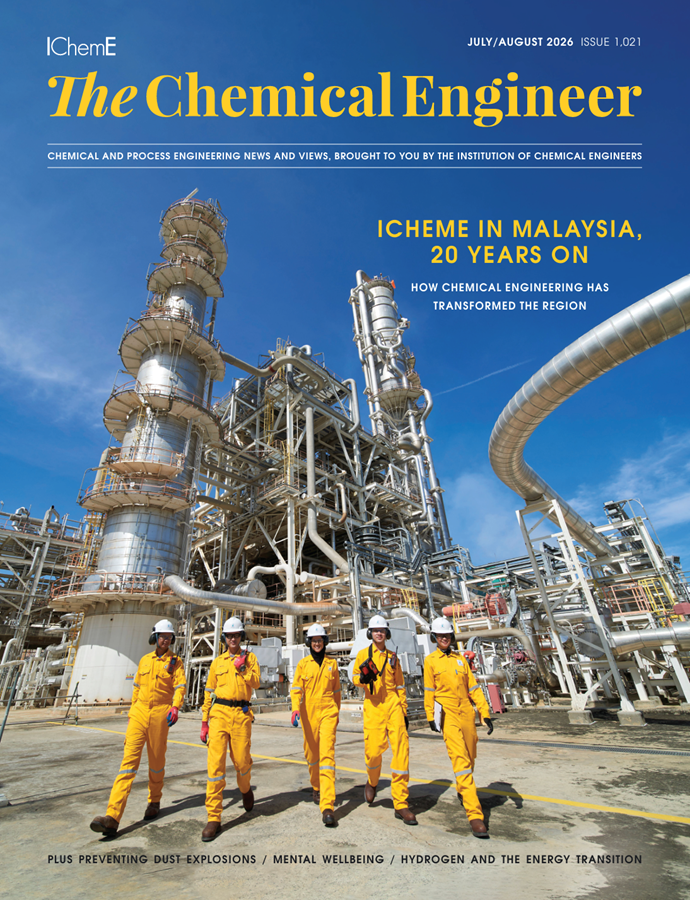
Catch up on the latest news, views and jobs from The Chemical Engineer. Below are the four latest issues. View a wider selection of the archive from within the Magazine section of this site.