The Process Scaleup Journey Part 3: TEA & LCA – Finding the Balance
CPI has helped over 1,000 businesses bridge the gap from beaker to bulk. In the third of the series, Hannah Mullard explains how dual assessments help innovators make technologies both economically viable and sustainable
Quick read
- TEA and LCA address different sustainability dimensions: TEA focuses on economic and technical viability; LCA evaluates environmental impacts – both inform decision-making
- Trade-offs between cost and environmental impact are common: A technology may perform well economically or environmentally but rarely both without careful design
- Early, combined TEA and LCA de-risk innovation: Applying both from low TRLs guides design choices, reduces scaleup risk and supports credible investment decisions
INDUSTRIES under pressure to cut emissions, conserve resources and control costs are turning to new technologies for answers. These challenges demand innovation that prioritises both economic viability and sustainable production. But what does sustainable innovation really mean? Is technology that offers environmental benefit truly sustainable if it is not affordable? And can a profitable product be considered sustainable if it poses a negative impact on the environment?
At CPI, we come across these questions frequently when carrying out Techno-Economic Analyses (TEAs)1 and Life Cycle Assessments (LCAs).2 This article dives deeper into how the two assessments differ, where they overlap and how together they can be used to strike a balance between economic feasibility and environmental responsibility.
TEA and LCA explained
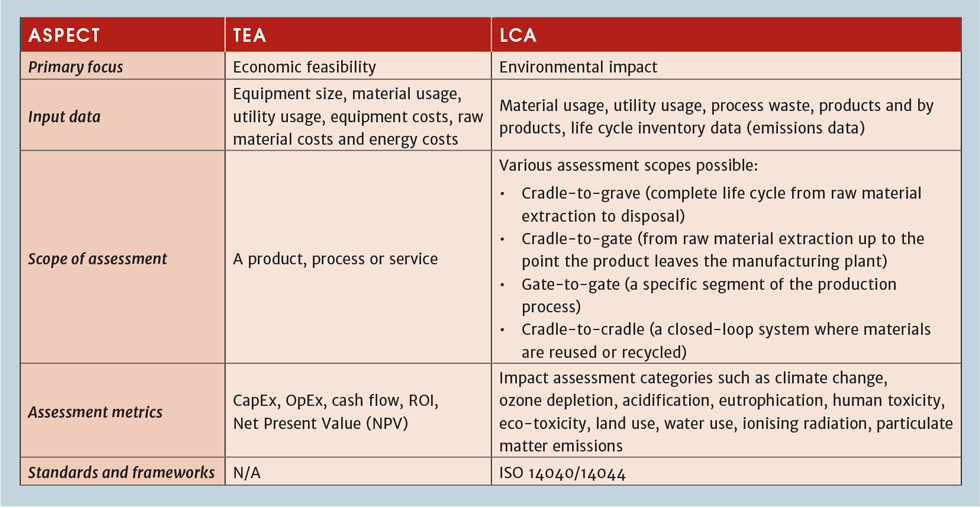
A TEA is a systematic approach used to evaluate both the technical feasibility and economic performance of a specific process, product or service. Within a TEA, a mass and energy balance is used to define the unit operations and an equipment selection study identifies equipment that can reliably support the process at the required scale. A TEA also evaluates economic indicators such as capital expenditures (CapEx), operating expenditures (OpEx), cash flow and return on investment (ROI).
An LCA, in contrast, is a structured framework for evaluating the environmental impacts associated with all stages of the life cycle of a product, process or service. It assesses a variety of environmental indicators, including global warming potential, ozone depletion, acidification, eutrophication, human toxicity, water depletion and land use.
Overall, TEA focuses on economic and technical feasibility as well as market viability, while LCA addresses environmental sustainability. Table 1 compares the two assessments.
The balancing act
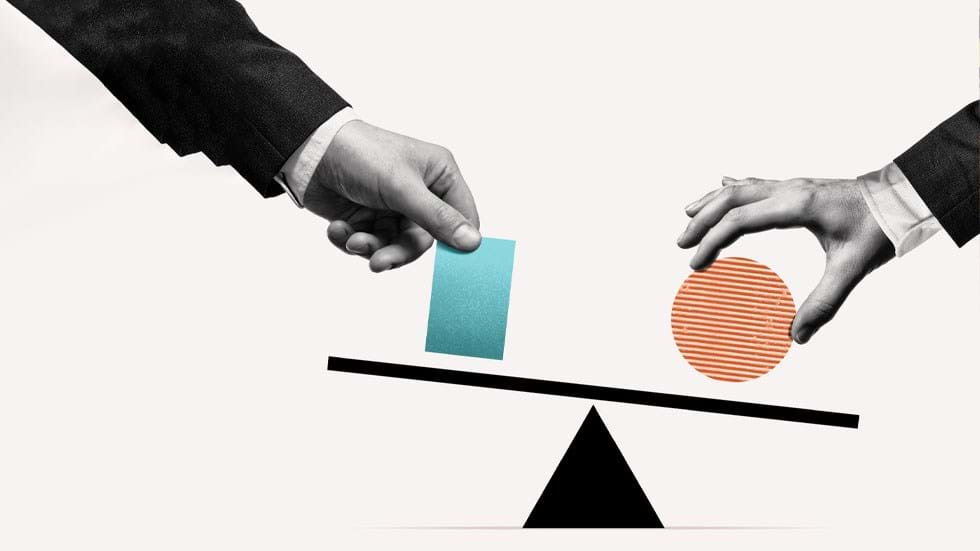
TEA and LCA often complement one another. A process that utilises less raw materials and less utilities will generally have a reduced operating cost (TEA) as well as a reduced environmental footprint (LCA). However, the two methodologies can also contradict one another.
Through our work at CPI, we see the balancing act that often emerges between environmental sustainability and economic viability.
Biofuels are a classic example. They can be economically attractive – with established markets, government incentives and mature production systems – and they emit less CO2 during combustion than fossil fuels. Yet depending on how they are produced, biofuels can also drive deforestation, water depletion and biodiversity loss. A TEA may show profitability, while an LCA highlights significant environmental risks.
Direct air capture (DAC) presents the opposite challenge. Environmentally, DAC has huge potential as a negative-emissions technology when powered by renewables. But the extremely low concentration of CO2 in air makes the process energy-intensive and costly, leading to high OpEx and slow commercial adoption. Here, the LCA is favourable, but the TEA highlights major economic barriers. Understanding these trade-offs early prevents costly surprises later – whether in engineering design, regulatory approval or commercialisation.
Why TEA and LCA matter from the start
At CPI, we recognise the value of involving both TEA and LCA from the earliest stages of innovation, especially as concepts progress towards scaleup.
Often, innovations demonstrate promising results in the laboratory but behave differently when scaled (as discussed in TCE 1,013: From Innovation to Commercialisation). A TEA based on data from the lab, but accounting for the limitations of large-scale operation, can be critical to prove a route to market and secure vital investment. Similarly, conducting LCAs during the early stages of development allows potential environmental concerns that could impact the long-term credibility of technologies to be identified. In fact, funding bodies such as Innovate UK and EU Horizon are increasingly requesting or strongly encouraging the inclusion of these assessments in relevant funding calls.
One of the most important business applications of a TEA and LCA is to guide strategic decision-making. Both assessments provide hotspot analyses which help decision-makers identify engineering design or process changes that would provide the greatest economic and environmental gains. Thus, this insight can lead to essential changes that allow the innovation to succeed at commercial scale. To illustrate, an early stage LCA could identify a hotspot unit operation with regards to environmental impact and inform the need to optimise or replace this processing step to ensure the process can be environmentally sustainable.
Bringing TEA and LCA together
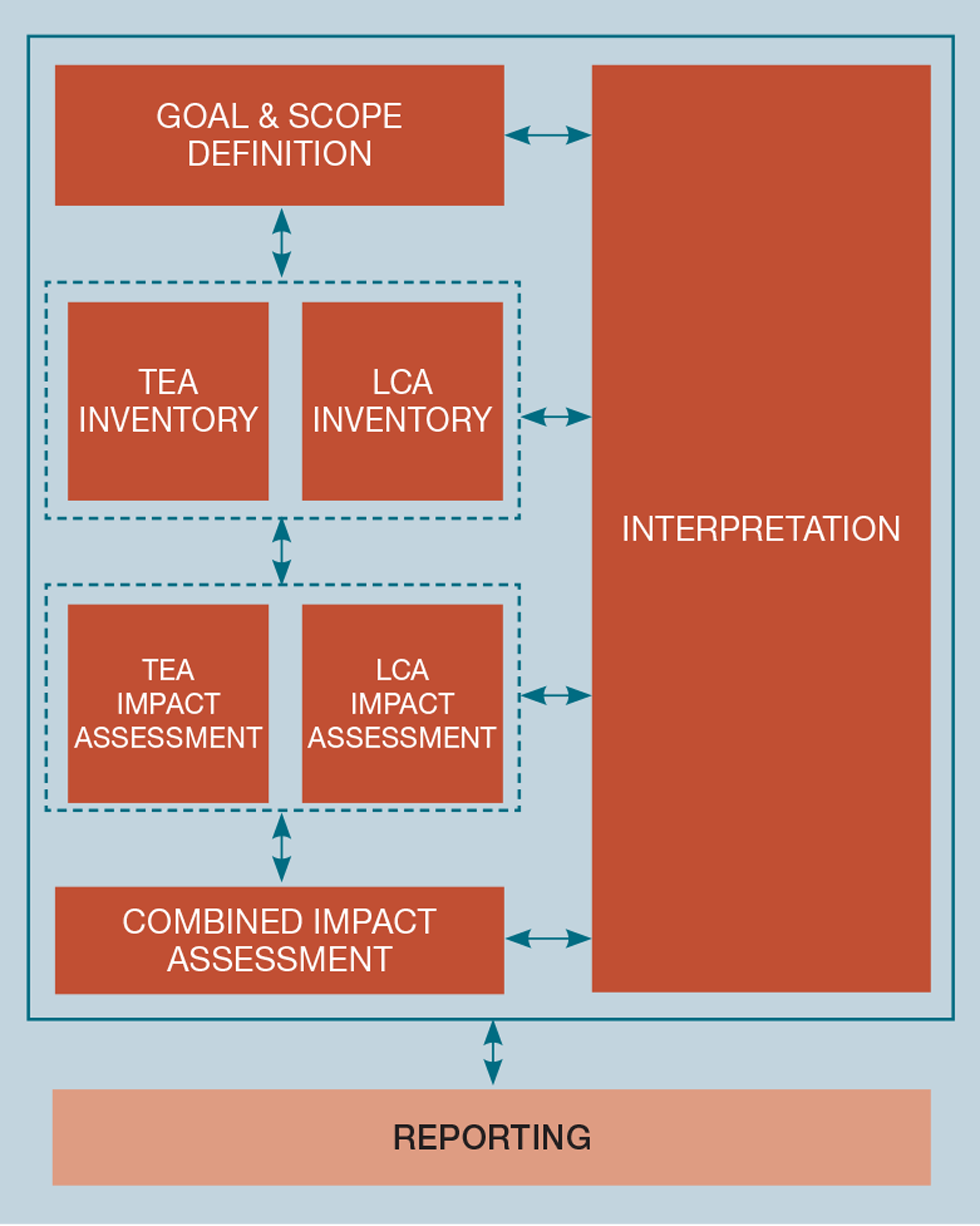
Currently, there is no universally accepted framework for integrating TEA and LCA methodologies. However, in line with the growing demand for balancing economic viability with environmental sustainability there is an increasing requirement for a unified approach.3 For example, a TEA may highlight the high costs associated with a technology. However, if the LCA demonstrates substantial emission reductions, the combined insight could still justify a business case.
Consequently, regulatory bodies and industry experts have begun to suggest approaches for integrated assessments. The Global CO2 Initiative recommends conducting TEA and LCA in parallel with a shared goal and scope. This approach ensures consistency in boundaries, timeframes and assumptions.
TEA and LCA both have well established software tools. The challenge often arises when bringing the two together which requires navigating multiple platforms and datasets. At CPI, we address this complexity and help to bridge the gap between the two tools by running the assessments in tandem.
Getting the timing right
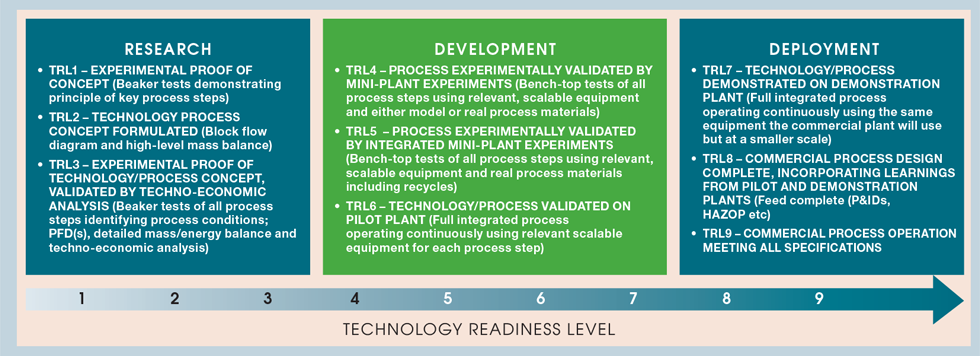
Technology Readiness Levels (TRLs) indicate the maturity level of products, processes or services. While we would always advise to start looking at the economics of your process as early as possible, TEAs typically begin around TRL 3 when the experimental proof-of-concept data becomes available to enable preliminary economic analysis. At this stage, TEAs rely on high-level inputs such as feedstock materials, estimated product yields, approximate CapEx for key unit operations and expected product value. These preliminary TEAs provide early-stage economic viability checks and can guide whether a project should progress.
As technologies advance through the TRL scale, improved data quality and process definition allow for more detailed assessments. The most significant insights from TEA usually emerge during TRLs 4–6, when the process design begins to take shape and key engineering decisions are made.
LCA standards ISO 14040 and ISO 14044 do not specify when an LCA should be performed. As with TEA, the accuracy of an LCA increases as the technology matures and more reliable data becomes available. As a result, CPI recommends different sustainability and LCA approaches depending on the relevant TRL.
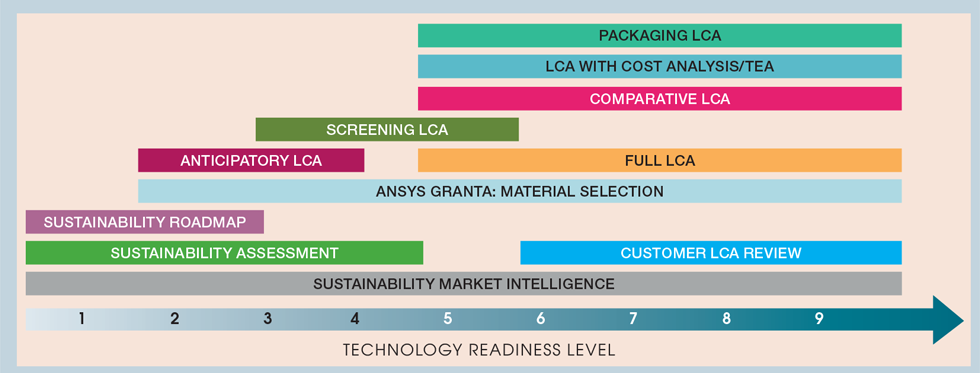
A full, comprehensive LCA is typically preferred at a TRL of 7 to ensure sufficient data is available. However, LCAs can be undertaken at earlier stages, provided appropriate assumptions are used to address data gaps.
Different LCA types align with different stages of development. For example, an anticipatory LCA can be used to inform decision-making during the early design phase (TRLs 2–4), while a screening LCA is useful between TRLs 3–6 to highlight major environmental “hotspots” within a product’s life cycle. Overall, a wide range of LCA and sustainability can be applied across all TRLs to evaluate environmental impacts throughout the innovation journey.
FluoRok: a real-world success story
A recent project with FluoRok demonstrates how early, combined TEA and LCA can reshape an innovation pathway. FluoRok, a University of Oxford spinout, are tackling the electric vehicle (EV) value chain bottleneck and are addressing challenges surrounding the use of toxic hydrogen fluoride in fluorochemical manufacturing. The company has developed alternative production pathways for fluorinating agents and lithium hexafluorophosphate (LiPF6) – a critical component in lithium-ion batteries – supporting the transition to a cleaner, low-carbon automotive sector.
When the Innovate UK-funded collaboration between FluoRok, CPI and the University of Warwick began, the technology was at TRL 3. CPI carried out parallel TEA and LCA assessments and provided early insights into energy demand, process hotspots and environmental trade-offs. FluoRok rapidly integrated these findings into process design, improving efficiency with minimal loss in yield. The combined TEA and LCA demonstrated a clear, economically and environmentally viable route to market, enabling the technology to advance to TRL 5.
This clarity helped FluoRok secure a further £1.5m (US$2m) from the Advanced Propulsion Centre in 2025 to build a UK-based demonstration facility. CPI continues to support the team, applying TEA and LCA to validate the viability and sustainability of this process at every stage of the scaleup.
Conclusion
Sustainable innovation requires more than a good idea. It demands clear evidence that a technology can scale economically and operate responsibly. TEA and LCA together provide this evidence, revealing trade-offs and opportunities that shape engineering design, investment decisions and long-term viability.
Integrating TEA and LCA from the earliest stages can unlock funding, reduce risk, guide scaleup and accelerate commercialisation. At CPI, we specialise in applying these tools to help innovators navigate this journey – ensuring that the technologies of tomorrow are both economically competitive and environmentally sound.
If you have any questions about TEA or LCA or would like to discuss how CPI could support you in more detail, please get in touch with Hannah at customerservice@uk-cpi.com or find her on LinkedIn
References
1. Environmental management - Environmental techno-economic assessment - Principles, requirements and guidance: bit.ly/iso-tea-guidance
2. Techno-Economic Assessment & Life Cycle Assessment Guideline for CO2 Utilisation: bit.ly/3MAUZ1T
3. R Mahmud, SM Moni, K High & M Carbajales-Dale (2021). Integration of techno-economic analysis and life cycle assessment for sustainable process design – A review. Journal of Cleaner Production, Vol. 317
4. Life-Cycle and Techno-Economic Assessment of Early-Stage Carbon Capture and Utilization Technologies – A Discussion of Current Challenges and Best Practices: https://doi.org/10.3389/fclim.2022.841907
Recent Editions
Catch up on the latest news, views and jobs from The Chemical Engineer. Below are the four latest issues. View a wider selection of the archive from within the Magazine section of this site.