The Medium that Made the Modern World: Part 2: Paper as Money and More
Paper was more than just a means of spreading words, writes Martin Pitt. It was an enabling technology for many other key operations in the modern world

THE CHINESE coin called cash was in the form of a disc with a square hole in the centre and moulded text giving its value from the fourth century BCE. The square hole meant the freshly moulded coins could be fixed on a square rod and rough edges filed off at the mint. They were generally made of copper mixtures. The Emperor Taizu of Song (r. 960–976) standardised them so that his coins were still used mixed with modern ones up until 1912.
However, Taizu had a problem. The economy was booming and there was not enough copper to meet the spending requirements. He therefore took the idea of promissory notes, a sort of IOU, which had been used by merchants since the seventh century. The cash were strung on cords and worn around the neck for village shopping or on sticks of known numbers for accountants. However, for the larger purchases of trade, cartloads might be needed. Therefore, it was possible to deposit coins with a trusted merchant and receive a note of the amount, which could be collected again. In practice most of the money stayed still while the notes were traded. As credit card agencies do today, a small fee was taken for every transaction.
Taizu authorised certain merchants to hold coins (effectively banks) with official promissory notes. In 1023 these were nationalised and standard government woodblock-printed paper currency issued the following year, considered the first proper paper money. A printing plate dating from 1214 for notes 10 x 19 cm worth 100 strings of 80 cash, has a serial number and a warning that counterfeiters would be decapitated.
In 1271 under the Mongol emperor Kublai Khan (1215–1294) paper currency was declared the sole legal tender for all the empire, which greatly aided economic expansion. The Venetian traveller Marco Polo (1254–1324) declared his astonishment at seeing the Chinese mint turn mulberry tree bark into pieces of paper treated as if they were gold or silver.
The next country to produce printed banknotes was Sweden in 1661. These were printed but hand-signed by a bank official to authenticate them. This was the practice for subsequent countries: the Netherlands in 1668, Scotland in 1695 and the Bank of England in 1697. The US issued some in 1776 to fund the Revolutionary War.
The Bank of England notes were from £10 (about a year’s earnings for a maid) to £100 (the price of a house). These proved popular among the very rich for gambling and more were issued, eventually leading to £500 and £1,000 in 1725, and to £1, £2 and £5 notes in 1787. With the smaller denominations, new betting shops in London enabled the middle class to gamble away money like their superiors. Banknotes increased in use and sophistication as forgeries appeared but became a staple part of 20th century societies. In the mid-19th century, a printed signature became accepted, since the increase in numbers was injuring the signatories.
Today the US prints about four billion banknotes annually, of a 75% linen 25% cotton blend or about 4,000 t of paper. Before the introduction of polymer notes, the UK printed about a tenth of this.
Cheques

The bank cheque is effectively a personal version of the promissory note. The first modern ones were issued by the Bank of England in 1717. To prevent fraud, they were printed on special cheque paper as numbered forms which had to obtained in person and had to be brought back to the same bank to be paid out. By 1770, with many banks issuing them, they could be brought to your own bank and credited to your account. Bank clerks met daily in a tavern in London to exchange cheques and settle the difference. This was the first clearing house. With cheques being used across the whole country, and later between countries, customers had to wait a certain time for cheques to be cleared. As well as dealing with the practical movement of paper, this gave the banks a period in which they held the money from a customer’s account and earned interest from it. The use of cheques has declined since the 1990s with electronic means of payment such as bank cards.
Postage stamps

In 1840, English social reformer Sir Rowland Hill (1795–1879) introduced a vastly simplified and efficient British postal service with a tiny, printed picture of the monarch which could be bought for one penny, stuck on a letter and cancelled by the post office to show that the service had been paid for. Called the Penny Black, the ink was a mixture of carbon black and linseed oil, a paint which took up to two weeks to harden enough to be issued.
It was cancelled by a red Maltese cross made from red iron oxide in linseed oil, supposed to be irremovable. However, the large pigment particles did not penetrate the hardened black ink and the fresh red ink could be carefully removed with common household solvents. As a result, there was widespread fraud, and just nine months later the stamp was replaced by the Penny Red. Its red pigment was fully fixed to the paper, while the cancellation ink used finer carbon black particles with a stickier resin, making it much harder to remove. Later the Twopenny Blue had the inorganic pigment Prussian blue.
In 1848, Irish lawyer Henry Archer (1799–1863) patented a machine to perforate sheets of stamps, which became standard from 1854.
The 1867 sixpence stamp was coloured with a new synthetic dye, Perkin’s mauveine. Other dyes from coal tar (see TCE 1014/5 Old King Coal Part 4: coal colours) encouraged a whole range of coloured stamps to be produced for the UK and the British Empire and the new hobby of philately.
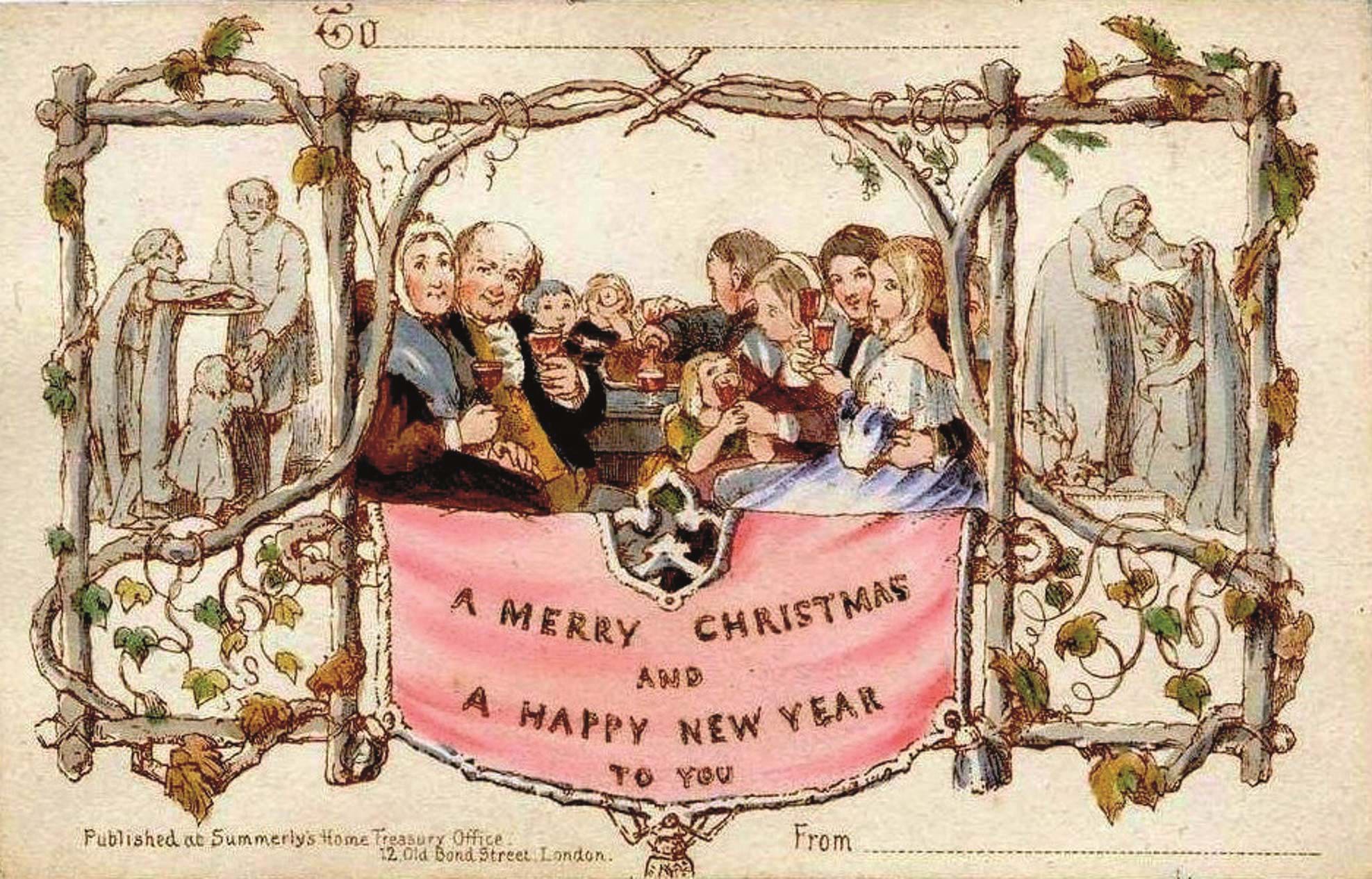
Within months of the first stamp the first picture postcards appeared, becoming common purchases for people on holiday. From 1894, postcards with humorous (and often rude) cartoons on them were sold at seaside resorts. The first mass-produced Christmas card was sold in 1843, designed by the English painter John Callcott Horsley (1817–1903). Birthday cards followed in the 1900s, ultimately consuming vast amounts of paper.
At this time in London, many postboxes were emptied eight times a day and in business districts there could be more than ten deliveries a day. It was thus feasible in cities to transact business by letters back and forth as quickly as can be done by email today. In fact, mail between big cities was not much slower, since letters were sorted on trains overnight and bags of mail could be picked up or dropped off at towns on the way without stopping. A train leaving London at 9pm arrived in Glasgow at 6am having stopped at six English cities and Edinburgh and transferred mailbags at many intermediate towns. A letter posted in the early evening in one city could be delivered with the first post next day in many other cities. By 1936, the Post Office was the largest employer in Britain, all because of cheap paper.
Letters were initially on sheets of paper folded over but in 1845 engineer Edwin Hill (1793-1876), the elder brother of Rowland, patented a machine which cut and folded paper in a convenient shape and put gum on some overlapping edges – the envelope. This was mass-produced shortly after and by the 1870s became part of normal correspondence.
Postage stamps were copied by other countries and enabled a remarkable change to society in communication and transport of smaller items.
Tickets

The first printed railway ticket was issued in 1838 for a journey from Derby to Birmingham. It had been invented by former stationmaster Thomas Edmondson (1792–1851), by profession a cabinet maker, who had built a machine (largely from wood) to produce them. Prior to this, tickets had been handwritten using the methods of the stagecoach, totally inadequate for the greater numbers of passengers on trains. It was a sophisticated system with serial numbers, fixed fares and date-stamped, all on easy-to-issue and -check small pieces of thick paper. It made him a fortune and helped the railways to expand enormously. The new profession of ticket inspector shortly followed. By 1860 the Edmondson ticket was effectively a global standard for France, Germany, US, India and Australia, lasting until 1990 in the UK.
Tram and bus tickets followed, giving an enormous simplification and efficiency for both passengers and companies.
Computers

In 1725 French weaver Basil Bouchon (?) had the idea of punched paper rolls for draw-looms to control the movement of needles. It was French automaton inventor Jacques de Vaucanson (1709–1782) who changed this to a series of rectangular cards joined together in a chain but it was not commercially viable. In 1794 French weaver Joseph M Jacquard (1752–1834) saw the machine and in 1804 demonstrated an improved machine operating automatically, for which he received a patent. Jacquard looms revolutionised the textile industry. The idea was taken up for music rolls or continuous folded paper, operating the fairground organ in 1892 by Italian organ builder Giacomo Gavioli (1786–1875) and the player piano or pianola in 1896 by American piano maker Edwin S Voley (1856–1931).
Computer pioneer Charles Babbage (1791–1871) used punched cards for his attempts to build an analytical engine, one set to program and another to feed data.

German-American statistician Herman Hollerith (1860–1929) used punched cards for processing data in the 1890 US census, with the data collected by an electromechanical tabulating machine he had invented. Around 100m cards were created from questionnaires with hole punches. The census was completed in one year, instead of eight for the 1880 one. He had seen railway conductors punching holes in different places on railway tickets to record certain features of the passenger and the journey and had first experimented with punched paper tape.
Further tabulating machines were produced for accounting and social security purposes. In 1911 his company was combined with some others and in 1924 the group was renamed International Business Machines (IBM). In 1937 IBM produced up to ten million cards a day for customers. Punched cards continued to be used until the late 1970s when they were displaced by magnetic storage.
Meanwhile the punched paper tape discarded by Hollerith had been adopted for telegrams from 1846. The presence or not of five holes in a row gave codes for letters of the alphabet, numbers, punctuation and (from 1901) some control symbols. The 1930s teleprinter keyboard punched the tape, instead of sending it directly like a telegraph. The tape could now be fed into a reader which operated faster than a typist, meaning that more signals could be sent down one wire in a batch mode. The message could be repunched at the other end, printed or forwarded to several places. During World War Two, punched paper tape was used to feed data into the Colossus computer at high speed for decrypting German messages. After the war, paper tapes were used for numerically controlled machine tools and began to replace cards for program entry for early computers.
During World War Two, punched paper tape was used to feed data into the Colossus computer at high speed for decrypting German messages

In the 1960s and early 70s paper tape use was at its peak for telecommunications, numerical control and minicomputers but it gradually faded in favour of magnetic media.
In 1959 the IBM 1403 line-printer was introduced, to the delight of programmers. Effectively an enormously fast electric typewriter, it could print 600 lines of text a minute (later 1,400) on wide fan-folded “green bar” paper from boxes containing over half a kilometre in length. Programmers printed many versions of programs and output to the delight of the paper suppliers and collectors of paper for recycling, of which this was the cleanest and most consistent. By the 1980s about 5,000 t was used per year in the US.

Around the same time, fan-folded paper started to be used with dot-matrix printers for bulk office tasks (along with a “burster” which separated it into separate sheets) such as mass mailing or invoices. In the 1990s the US alone was using a billion sheets a year. It started to decline in the 2000s with the introduction of inkjet and laser printers and is in minority use today.
Paper cards and tape were a key part of the development of computing technology. Paper was essential for programmers.
Increased digitisation has finally reduced the use of paper in the office by about 30%, not yet paperless! This has been offset by an increase in paper for packaging, which I will deal with in a later article.
Martin Pitt CEng FIChemE is a regular contributor. Read other articles in his history series: https://www.thechemicalengineer.com/tags/chemicalengineering-history
Recent Editions
Catch up on the latest news, views and jobs from The Chemical Engineer. Below are the four latest issues. View a wider selection of the archive from within the Magazine section of this site.