The Downstream Challenge of Cultivated Meat
The cultivated meat industry promises a more sustainable way to produce protein. But making it truly animal-free may depend on advances in downstream processing. Aniqah Majid reports
MODERN livestock farming struggles to meet rising global food demand without heavy environmental cost. Research from Stanford University estimates that livestock production accounts for around 16% of global greenhouse emissions and 32% of methane emissions. Two-thirds of agricultural land is used to grow animal feed, compared with just 8% for crops consumed directly by humans.
Cultivated meat has been promoted as a more controlled and potentially lower-impact alternative. Instead of slaughtering animals, stem cells are extracted and grown in bioreactors to form real muscle tissue. In principle, the process could use less land and water while improving animal welfare.
But one major obstacle remains: the cell culture media.
"The world is rapidly looking for larger access to quality protein for humans, but the planet is under stress with the welfare of livestock. Biochemical science offers a solution"
Cells require a nutrient-rich "soup" to grow. For years, researchers have relied on foetal bovine serum, derived from cow foetuses. It is expensive - often more than £300 per litre - and its use sits uneasily with the industry's animal-free ambitions. Media must be replaced as nutrients are depleted, adding cost and environmental burdern.
This is where downstream processing enters the picture.
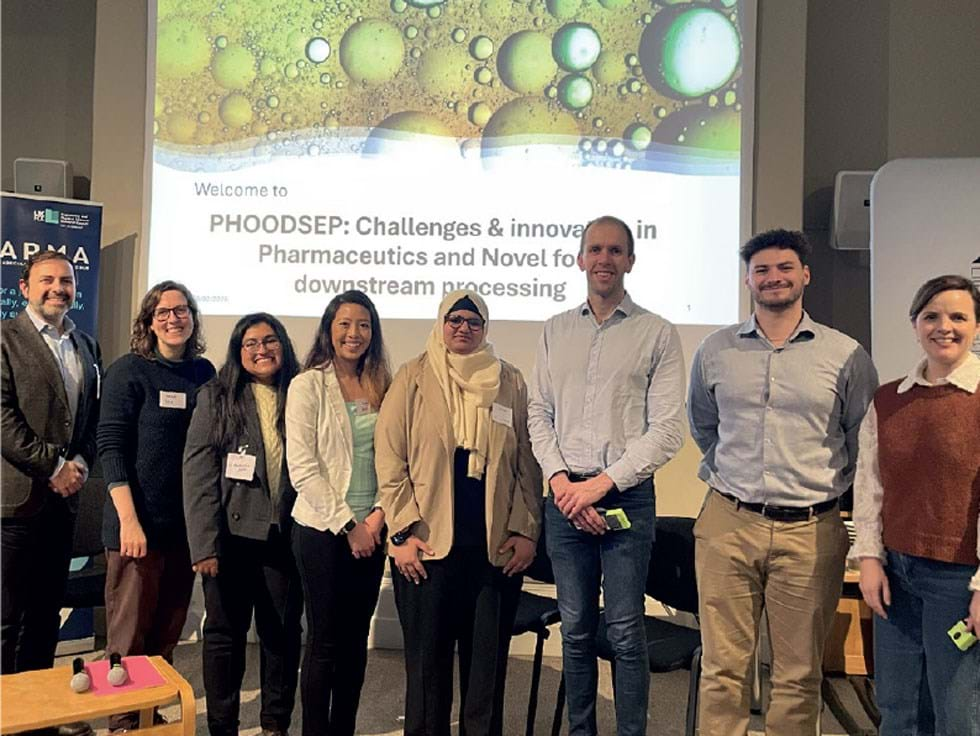
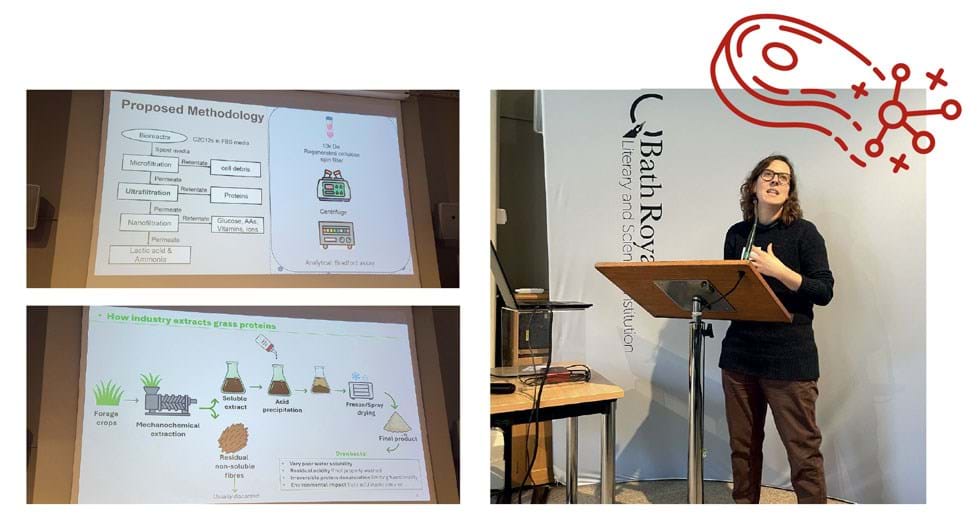
In February, the Cellular Agriculture Manufacturing (CARMA) hub and the IChemE hosted a symposium at the Bath Royal Literary and Scientific Institution to explore the innovations of downstream processing in the pharmaceutical and food industry. Led by Fatima Anjum, a research associate at the University of Bath and a member of CARMA’s academic team, the event’s many focus areas included recycling spent media and developing alternatives to animal-derived serum.
Precision fermentation
CARMA has an extensive portfolio of work packages with specific research aims in cultivated meat production. Work Package 2 centres on product purification and waste valorisation. The aim is twofold: recover valuable nutrients from used media and develop non-animal replacements using precision fermentation.
“Amino acids are the biggest contributor to cell media and media is the biggest contributor to the climate impact of cultivated meat,” explains Hannah Leese, a chemical engineering lecturer at the University of Bath and CARMA’s Work Package 2 lead.
“We are working with the Clean Food Group and professor Chris Chuck from the University of Bath to look into oil-rich yeasts – taking a byproduct of oil, which again can be a food-grade yeast and processing it into different food products, whether it goes into the final meat product or additional products like palm oil alternatives."
Yeast as feedstock
Oil-rich, or oleaginous, yeasts are emerging as promising feedstocks. Research associate Fatima Anjum is developing greener solvents to replace hexane in lipid extraction from yeast, improving the sustainability of bio-oil production.
Meanwhile, at University College London, research fellow Ehsan Nourafkan is applying downstream processing techniques to baker’s yeast, Saccharomyces cerevisiae, to create substitutes for nutrients typically supplied by mammalian serum.
He explains: “First CARMA sends us the yeast – an ideal microorganism for this process. Our team at UCL are responsible for extracting the nutrients and proteins by disrupting yeast biomass using high-pressure homogenisation, followedby using alkaline hydrolysis to extract the protein.”
The resulting yeast hydrolysate can then be fractionated using vibratory tangential flow filtration to generate components capable of partially replacing foetal bovine serum.
Nourafkan's research has reduced the amount of serum required in experimental media - an incremental but important step towards scalability.
Animal-free meat
Fully animal-free media may not be far off. Roslin Technologies says its cell lines are grown entirely without animal serum: “One of the benefits of our cell lines is our novel media which does not contain animal serum – the cells we produced are serum-free whilst they are grown and continually passaged.”
Other companies, including German startup The Cultivated B, are developing synthetic alternatives derived from guanylhydrazones – small organic compounds designed to mimic the growth-promoting components of animal serum.
For Nourafkan, the broader direction is clear: “The world is rapidly looking for larger access to quality protein for humans, but the planet is under stress with the welfare of livestock. Biochemical science offers a solution.
“Mammalian cells are a product of millions of years of evolution but unfortunately are very expensive and in poor access. So, cultivating them in a bioreactor and feeding them nutrition that comes from microorganisms like yeast to develop high quality proteins is a fantastic idea and the amount of companies looking into this is only going to get bigger.”
Cultivated meat may promise cleaner protein. But whether it delivers on that promise could hinge less on the bioreactor itself – and more on what chemical engineers can recover, refine and replace downstream.
Recent Editions
Catch up on the latest news, views and jobs from The Chemical Engineer. Below are the four latest issues. View a wider selection of the archive from within the Magazine section of this site.