Taking fashion full circle

In a world dealing with ever more plastic-based textile waste, Aida Rafat, CEO of DyeRecycle, is using chemical engineering to make fast fashion sustainable. Aniqah Majid reports
Think about all the clothes you have ever worn in your life. Some you may still have, but what about the others? Your favourite coat when you were little? That Christmas jumper from 2006?
“They are probably sitting in a landfill site somewhere,” says Aida Rafat, the chemical engineer who today runs DyeRecycle, a company that uses solvent-based technology to decontaminate post-consumer textile waste and put it back into the supply chain.
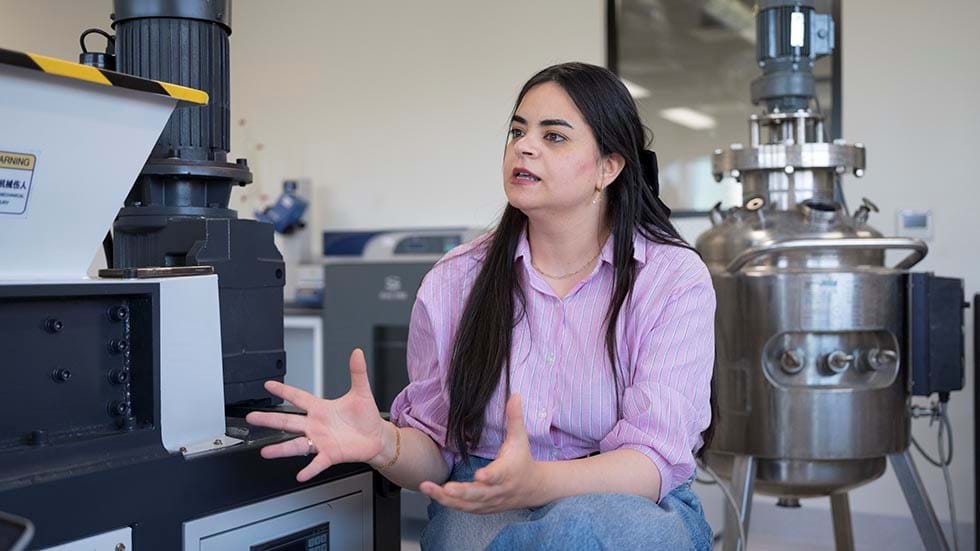
I meet Rafat at DyeRecycle’s office at Imperial College London Scale Scape Campus in White City London. In her pristine lab, she illustrates to me the colossal size of the textile industry’s waste problem.
Rafat’s awareness of the problem began in the way many of us may have also learned about such a situation: a damning documentary on Netflix. “
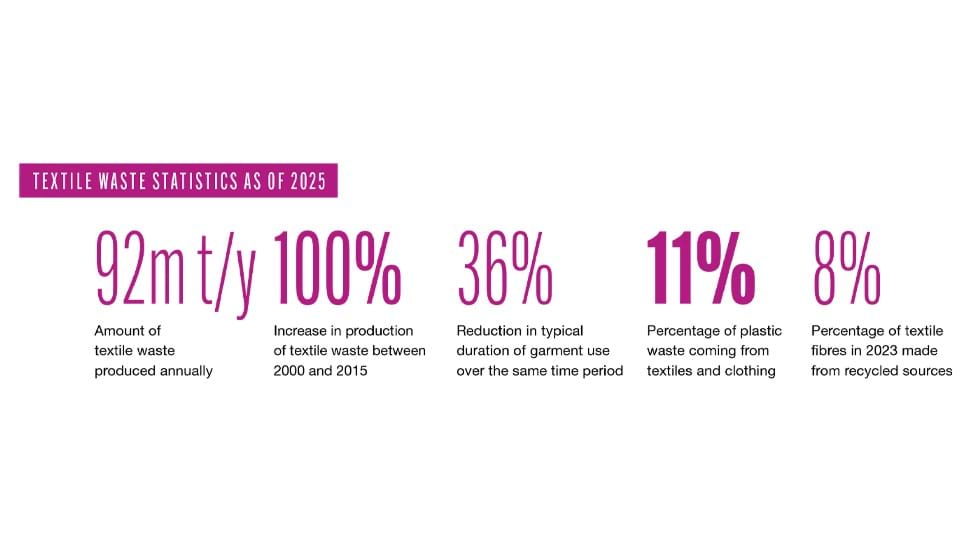
It was quite shocking for me as I had no idea about the impact of the textile industry. I was quite taken aback by how serious this challenge is – the fact that there is 92m t/y of textile waste that is generated, and less than 1% is recycled.”
Fortunately, Rafat was perfectly placed to think the issue through, as she was studying for a PhD at Imperial College London – and researching the development of sustainable chemical technology.
A background in chemical and environmental engineering, as well as an interest in the circularity of chemical processes, gave her the skills to tackle this largely “opaque” industry.
“I knew little about chemical engineering before starting my BSc degree,” she tells me, “but it ended up being the best decision I could have made at a young age.” Rafat grew up in Qatar, where process engineering through oil and gas is an everyday sight. Moving around this environment,
Rafat found herself wanting to know how everything was manufactured – and how, with oil and gas, engineering provided the foundations for whole economies.
Aida Rafat's CV
Education
- Qatar University: a bachelor’s in chemical engineering and master’s in environmental engineering. Graduated in 2014.
- Imperial College London: PhD in chemical engineering. Graduated in 2021.
Career highlights
- 2011 Qatar Chemical Company: a chemical engineering intern troubleshooting steam reactors at the Normal Alpha Olefins plant.
- 2014-16 ConocoPhillips: assistant engineer at the Global Water Sustainability Center to study technology related to produced water and desalination.
- 2021-22 Postdoctoral researcher at the Qatar Foundation: investigated innovative sustainable ionic liquid-based processes to divert waste from landfill and valorise it to value-added products. Developed a new chemical process that selectively extracts proteins and cellulose from industrial sludge.
- 2022-24 Imperial College London and Royal Academy of Engineering Enterprise Fellow: research associate using chemical methods to remove and reuse dye from solid and water waste streams.
- 2023-present CEO and co-founder of DyeRecycle: leading a team developing a non-destructive process that removes these contaminants without degrading the fibre, transforming polyester-rich textile waste into premium reusable polyester.
She went to Qatar University for her bachelor’s in chemical engineering, staying on to complete a master’s in environmental engineering. After this she spent two years working for energy giant ConocoPhillips at its Global Water Sustainability Center.
“In Qatar, water has always been the biggest challenge,” says Rafat. “Desalination and wastewater treatment in general was a big research topic for me. Even while I was working in oil and gas, it was in water desalination.
With the processing of oil, there is a lot of water involved in that.” With the fundamentals of circular processing under her belt, Rafat ventured further in sustainable processing, specifically with chemical production. She was awarded a PhD scholarship from Imperial, where she got to work with its professor of sustainable chemical technology Jason Hallett – in particular, on researching the development of chemicals from waste streams.
Polyester and plastic fibre is found in many textile materials produced today. The principles behind recycling it are like those for plastic PET bottles: the more homogenous and “white” the material it is, the easier it is to recycle.
This, Rafat explains, is the biggest problem with textile waste – the material is rarely white. The many different colours involved create the energy-intensive and expensive problem of sorting between white and coloured materials.
During her PhD and research with Hallett, Rafat started a side project developing a solvent-based chemical process to strip waste material, mostly polyester, of its colours and contaminants, producing a white textile waste that could be processed back into polyester manufacturing and textile production.
She recalls starting out by experimenting with polyester materials obtained from charity shops, including a Santa Claus blanket that she still has (and is now framed in her office).
“I was taken aback by how serious this challenge is”
The process became the basis of DyeRecycle, which Rafat officially co-founded after her PhD in 2023 and which has been rapidly growing since.
The last few years have been a whirlwind of activity for Rafat and DyeRecycle, from developing its chemical process to navigating post-consumer textile waste.
The company’s journey has not been without its challenges, she admits. “Every startup has had the problem of having a technology platform that can do a lot of things, but finding what application has the biggest value in a short timeframe. So much of running a startup is about time and how fast you go to market, as you don’t have an infinite amount of resources or time to keep funding your growth.”
To ensure DyeRecycle’s business is competitive, Rafat says that the company is currently focused on processing a specific material.
“Our process allows us to recover the solvent we use to strip dyes from fabrics near-quantatively. This gives us a competitive advantage,” she explains. “Circularity plays a role in the process economics of our business, including the operating costs and capital expenditure; we have to choose operating costs that are feasible.”
She adds: “Even though our technology can in theory work with multiple feedstocks, including nylon and acrylic, we’ve had to focus our energy on polyester and poly-cotton fabrics. This works well from a commercial aspect as they are the most dominant fibres in textile waste.”
DyeRecycle’s balance between technical innovation and commercial viability also requires tackling a textile supply chain that has several bottlenecks to negotiate. “The fashion and textile supply chain is incredibly fragmented and opaque,” Rafat explains. “It is not straightforward, and a lot of fashion brands we have spoken to directly don’t have access to their own suppliers, or they don’t know anyone beyond their core manufacturers. As a technology that is part of the raw material side of the supply chain, it’s very far away from the brand itself.” She adds: “The brand is the very end customer for our technology. DyeRecycle’s direct customers are the polyester manufacturers. Between those two there are around five different stages, so having to align ourselves with both manufacturers and brands has been quite an interesting conversation.”
Scaling and leading
The last few years have been instrumental in DyeRecycle’s scaleup. The company has already acquired several prestigious awards, including the IChemE Global Sustainability Award in 2024, and has recently been shortlisted for the Manufacturing Futures – Fashion District’s innovation challenge.
Weaving the right team together
Chemical engineers work with large-scale processes. By definition, this makes the discipline one that is built on teamwork.
With DyeRecycle based on chemical processing, Rafat knew she needed a technical team of engineers, material scientists and business developers to take the technology from lab research to a feasible and profitable business.
With so many factors to consider in building a truly circular business, Rafat explains why having a diverse team is so important.
“I am so grateful to have built a strong technical and commercial team – you need a diverse skillset, where you have different people looking into the technology, the process and the R&D.”
Earlier this year DyeRecycle received mainstream recognition through a collaboration at London Fashion Week, where it worked with designer Patrick McDowell and supplied a red pigment made from recycled textile waste to dye a dress for the runway. For Rafat and DyeRecycle, this kind of recognition is crucial to communicate the importance and technological readiness of circular processes in textiles.
Rafat says: “You have to build a relationship with manufacturers and recyclers, but also with brands as they are the offtakers of our technology.”
The company is now gearing up to move into the next phase of operation, and is set on deploying its first pilot-scale facility in the near future. While continuing to build further connections with manufacturers and brands, Rafat hopes that soon DyeRecycle will be able to send out tonne-scale samples to customers to show the breadth of the technology. This jump will require investment and support, which Rafat is more than ready for.
“Someone once told me that if your role as a CEO is not changing every six months, you are not moving fast enough,” she said.
“This is a chemical technology we’re building, and being a technical CEO with a chemical engineering background is definitely an advantage because I understand the challenges, the language and the complexity of skills needed in our team to achieve our goals.”
Recent Editions
Catch up on the latest news, views and jobs from The Chemical Engineer. Below are the four latest issues. View a wider selection of the archive from within the Magazine section of this site.