Reaching Steady State: A Control Theory Lens on Navigating Early Careers in Chemical Engineering
Neerja Sonowal explores how concepts of stability and control can help make sense of early-career progression, particularly when progress feels slow or unpredictable
I WAS recently introduced to a cooling tower control rig for a lab assessment and my first look at the piping and instrumentation diagram (P&ID) felt like reading a foreign language. Despite the theory I’d learned in class, the labyrinth of micro-instrumentation and looping pipework left me with a single thought: where do I even begin? It was only through the steady guidance of our graduate teaching assistant and professors, and a collective team effort, that we began to decode the process step by step.

Looking back, it’s tempting to say “it all got easier with time,” but in truth the challenges only increased; we simply stopped fearing them. We began to welcome that wave of uncertainty, recognising it as a signal for a breakthrough or a new challenge. It became an opportunity to learn something we hadn’t before, and that was the real motivation.
Whether it’s a controlled process or a professional’s career, instability and unpredictability are often perceived as threats to growth. What is sometimes overlooked, however, is that instability is often the first sign that a system is responding to a real set of constraints instead of mere idealised assumptions. Time delays, oscillations and disturbances, which are often viewed negatively in early-career trajectories, are in fact distinctive features of a system operating in the real world. Reflecting on that experience made me wonder: what if the idea of tuning a system toward a desired state could also help us navigate our careers – helping us reach our own “steady states” in a stable, robust way?
One of the most useful ideas from control theory is the robustness trade-off.
What if the idea of tuning a system toward a desired state could also help us navigate our careers – helping us reach our own “steady states” in a stable, robust way?
The robustness trade-off: fast gains or firm foundations?
When my team and I began tuning our control system, we quickly realised we were not searching for a single “perfect” response. Pushing the controller to react quickly to a setpoint change often led to oscillations and instability, while designing for a smoother, more reliable response required accepting a slower system. In control engineering, this trade-off between speed and robustness is fundamental: a system optimised for rapid performance is often more fragile, while a robust system prioritises stability under uncertainty.
This balance is shaped by context. A safety-critical process may favour conservative tuning, while a less critical system might tolerate aggressive gains for faster response. There is no universally correct setting – only choices aligned with the system’s purpose and constraints.
Taking this theory-heavy analogy into real life, early-career decisions can be framed in terms of what trade-offs we are willing to accept, rather than whether we are progressing “correctly”. Visible gains like high grades, promotions or internships are often treated as the only meaningful metric, but they can come at the expense of robustness – deep understanding, adaptability and resilience to uncertainty.
A useful question, then, might be: At this stage of my growth curve, am I optimising for speed or for stability in the presence of real-world disturbances? Early careers are inherently noisy systems, influenced by rejection, shifting goals and imperfect information. Designing for robustness means accepting slower apparent progress while building a system that can withstand these disturbances without losing direction. In that sense, choosing stability over speed is not a conservative strategy – it is a deliberate tuning choice that acknowledges the realities of operating in a non-ideal environment.
How control theory plays out beyond the system
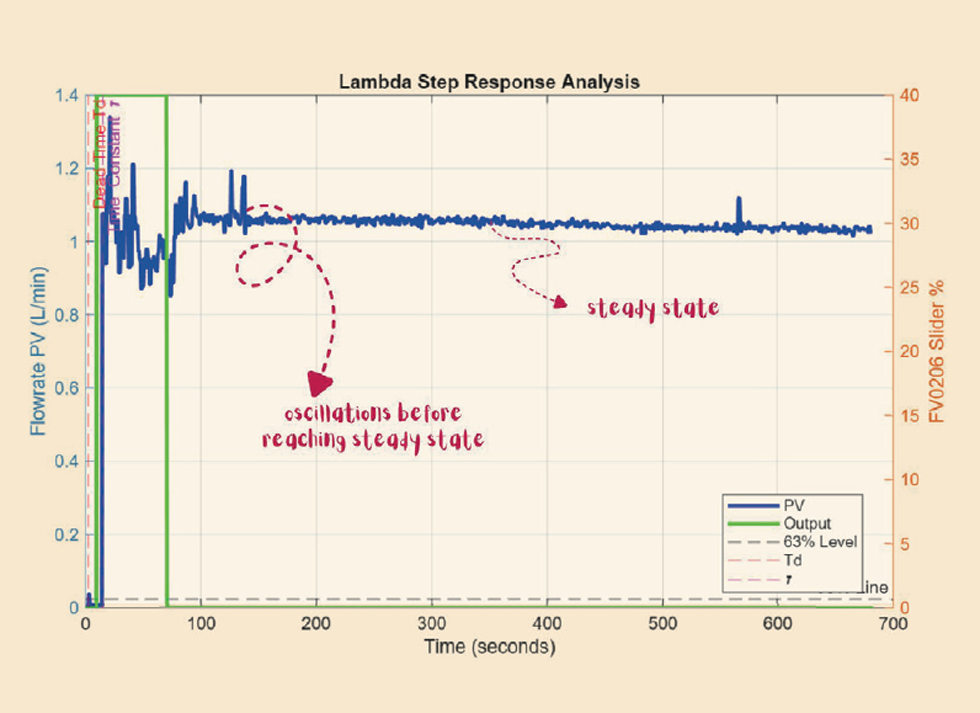
While control theory and career development may appear to be vastly unrelated, they share several underlying patterns. For my team, moving from simulation to a physical rig meant dealing with disturbances we couldn’t predict; high levels of noise in the system, high pressure readings and fouled filters messing with flow readings. An interesting parallel is that early careers can feel similarly noisy, shaped by factors like repeated applications, rejections, short-term placements or constant comparison with peers.
Systems may also exhibit oscillatory behaviour when responding to a change in setpoint, particularly if that change is introduced rapidly. In an early-career context, this can mirror the unease that accompanies transitions in role, environment or personal situations, where reactions and expectations fluctuate before settling. In both cases, the resulting discomfort is not a sign of failure but a natural response to change.
So, how do I tune my life - my system?
There were several methods we could use to tune our rig, from Ziegler–Nichols or lambda tuning to structural approaches such as feedforward, feedback or cascade control.
What tied these concepts together was the trade-off that higher controller gain accelerates response but erodes stability margins, while lower gain slows the system but improves disturbance rejection. For young professionals, tuning could differ just as much depending on one’s field of work, future goals and current skillset. What matters is prioritising purpose in a way that remains stable and sustainable, rather than constantly reacting to where we think we should be.
From oscillations to steady state
Besides highlighting how fascinating process dynamics and control can be, I hope this piece sheds light on the “startup phase” of our professional lives. What feels like stagnation may simply be dead time before the system responds. By tuning ourselves deliberately, learning from disturbances and prioritising stability over speed, we lay the foundations for a resilient career – progressing steadily toward our next operating point with confidence, clarity and control.
Neerja Sonowal is a second-year Chemical Engineering undergraduate at Imperial College London and articles lead for the IChemE National Early Careers Group
If you are an under-graduate or recent graduate and want to boost your network, you can find out more about the IChemE National Early Careers Group, including joining instructions, at bit.ly/icheme-necg
Recent Editions
Catch up on the latest news, views and jobs from The Chemical Engineer. Below are the four latest issues. View a wider selection of the archive from within the Magazine section of this site.