Fertiliser Reset

Inelastic demand and fragile supply chains are amplifying price shocks in fertiliser markets – driving renewed interest in efficiency, electrification and local production, as Gareth Forde and Max Barnes explain
Quick read
- Small shocks, big price swings: Fertiliser markets react strongly because demand is highly inelastic, so even minor supply disruptions drive sharp price increases
- Resilience over reaction: Long-term stability depends on improving efficiency, diversifying supply chains and expanding local and organic fertiliser options.
- Electrify and decentralise: Modular, electrified ammonia production offers a path to lower-carbon fertiliser made closer to where it is needed
SUDDEN price shocks to fuel and fertiliser are forcing politicians, industry and chemical engineers to rethink how these essential inputs are produced and used – from alternative feedstocks and electrification to supply chain diversification.
Australia offers a clear illustration of the challenge. In the three years to 2024–25, the country exported 71% of its agriculture production by volume, with wheat and beef particularly export-focused. Yet Australian farmers are faced with shortages of fertiliser and high diesel prices, raising questions over whether planting a winter crop is economically viable. In a severe scenario of fertiliser shortages compounded by low rainfall, economists estimate the 2026–27 output could fall by 25–30%.
If such a reduction in output were replicated globally for staple crops, the consequences for food prices could be severe. These dynamics are already playing out in fertiliser markets, where relatively modest supply disruptions have triggered sharp price increases.
Fertilisers such as urea are relatively inelastic commodities, typically with an elasticity of around -0.2 to -0.4 (compared with around -0.1 for staples such as wheat and rice and -1.5 to -2.0 for airline travel). This means a 15% supply reduction of urea – for example, due to geopolitical disruption to key shipping routes – could result in price increases of roughly 40–75%, depending on market conditions.
Data from the Illinois US Department of Agriculture broadly reflects this dynamic, with urea prices rising by 57% when comparing April 2026 with the 2025 average.
While governments have responded with measures such as stockpiling fertiliser and fuel, these interventions offer only short-term relief. As the saying goes, give someone a fish and they can eat for a day, teach someone how to fish and they can eat for life. A warehouse full of urea may provide a temporary buffer (and perhaps a nice photo in the broadsheets), but it does not address the underlying issue and leaves countries at the mercy of global supply chains.
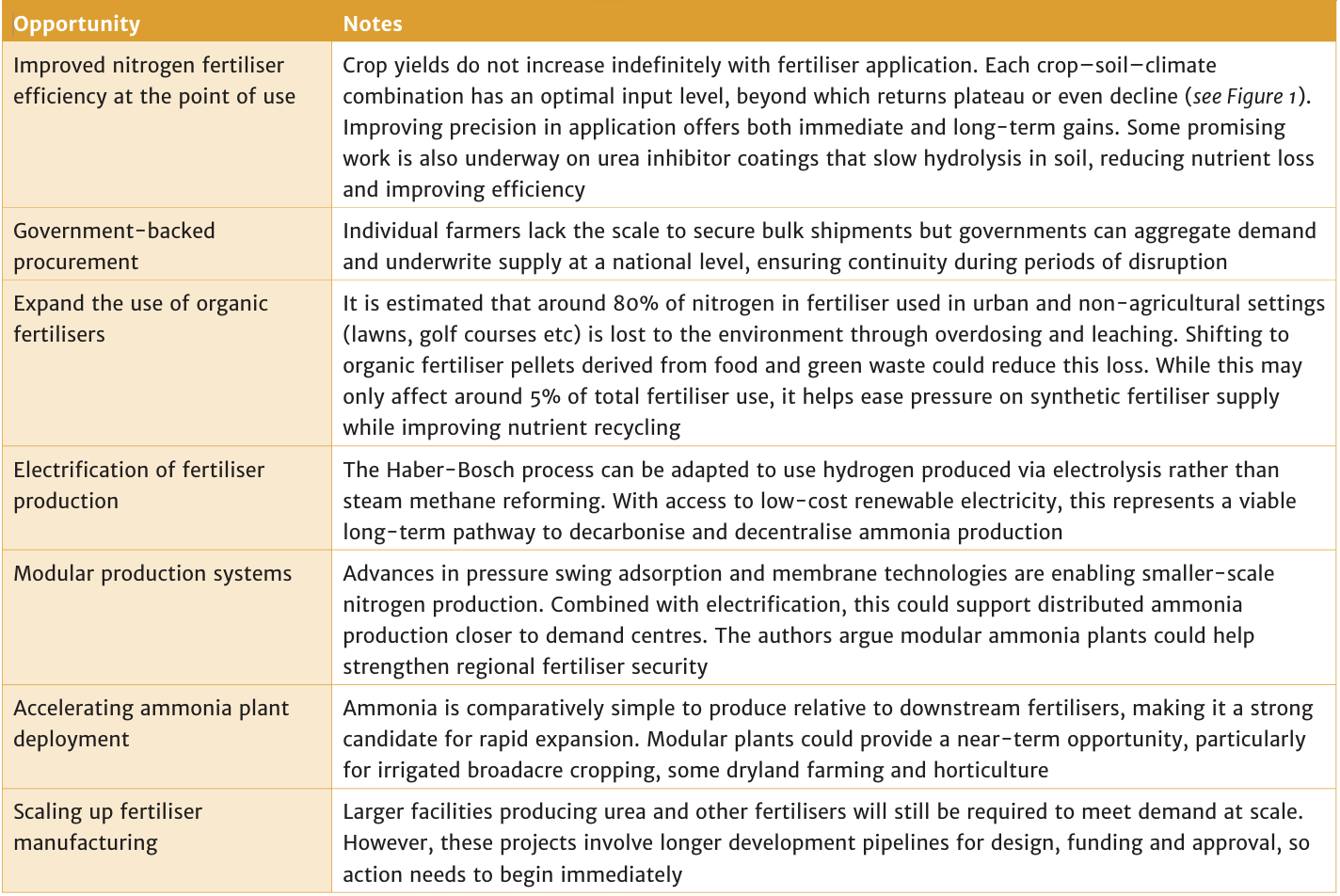
Instead, the current disruption presents an opportunity to rethink how fertilisers are produced, distributed and used. The table below outlines a raft of short- and long-term opportunities to reduce reliance on imports while improving efficiency across the system.
Among the options attracting growing attention is ammonia itself – not only as a fertiliser feedstock, but as a potentially lower-carbon alternative to conventional urea systems.
Anhydrous ammonia presents both an opportunity and a challenge. It is one of the most cost-effective sources of nitrogen fertiliser and can potentially be produced at much smaller scales than urea, creating opportunities for more distributed fertiliser production. However, ammonia is toxic and flammable, requiring specialised handling, storage and trained operators.
Urea remains easier to transport, store and spread, making it more practical for many large-scale agricultural applications. Yet that convenience comes with an emissions penalty.
Recent Editions
Catch up on the latest news, views and jobs from The Chemical Engineer. Below are the four latest issues. View a wider selection of the archive from within the Magazine section of this site.