The Process Scaleup Journey Part 5: What is Your Pilot Plant For?
CPI’s Andrew Bosman explains why successful pilot plants are designed to answer specific questions - not simply built bigger
Quick read
- Questions are crucial to scaleup: However, in piloting “why?” is the queen of questions
- Scaleup isn’t a straight path: Going back and checking the basics are correct and robust before building a pilot plant can save time and money
- Prioritise: If you attempt to answer every question with your pilot plant you’ll end up with no good answer to any of your questions
PILOT plants are often seen as the defining step in scaleup: the moment an idea leaves the laboratory and starts to resemble a commercial process. But before committing millions of pounds and years of development time, CPI has taught me the most important question to ask:
Why?
At CPI we regularly design, build and operate pilot plants for clients across a wide range of sectors. In almost every project, understanding the real purpose of a pilot plant is the difference between building something useful and building something unnecessarily expensive, slow or over-engineered.
Pilot plants are an essential tool for de-risking process scaleup. They help identify problems which are negligible at laboratory scale but can derail a full-scale process. These can include non-linear mixing effects, heat-transfer limitations, feedstock variability, solids handling issues, process control challenges and material compatibility problems.
Some of these risks are predictable. Mixing correlations, for example, are relatively well understood. Others only emerge when moving away from analytical-grade laboratory materials and working with real industrial feedstocks.
However, not every scaleup question requires the same type of pilot plant.
One question, two very different answers
Two CPI clients illustrate the point well.
Client A approached us with a novel reactor technology and needed to demonstrate it could operate safely at scale as their process involved explosive atmospheres.
Achieving this required a bespoke pilot plant using a novel stainless-steel reactor with safety features mitigating ATEX and other major hazards. The programme ultimately became a major capital project costing more than £5m (US$6.8m) and taking around 18 months to deliver.
Client B asked the same opening question: “Can you build us a pilot plant?” But their need was entirely different.
They wanted in this case, the solution was far simpler. The process could be accommodated in an intermediate bulk container with a top-mounted air-driven agitator inserted into the opening. The project was completed in one to two months and cost less than £50,000. The projects differed in cost by a factor of 100. However, both achieved the outcomes necessary for the customer. Neither of these were wrong paths. They are outcomes of different answers to “Why?”.
A phrase often used in engineering is: “First build the right thing, then build the thing right.”
That first step matters most.
If the purpose of a pilot plant is not clearly understood, even an exceptionally well-engineered facility can fail to deliver value.
The importance of asking "Why?" repeatedly
When we ask why, we need to find the root of the answer, not the first layer. This means digging through more than the initial response.
A client may initially say they need a pilot plant “to scale up”. But scale up for what purpose? To satisfy investors? To prove process safety? To generate product samples? To gather design data? To validate economics?
Like in root cause analysis, a great technique is the “five whys” approach to dig down and find the core of why we are building a pilot plant. It is critical because a pilot sits in a phase of the development cycle where copious quantities of cash start to be spent.
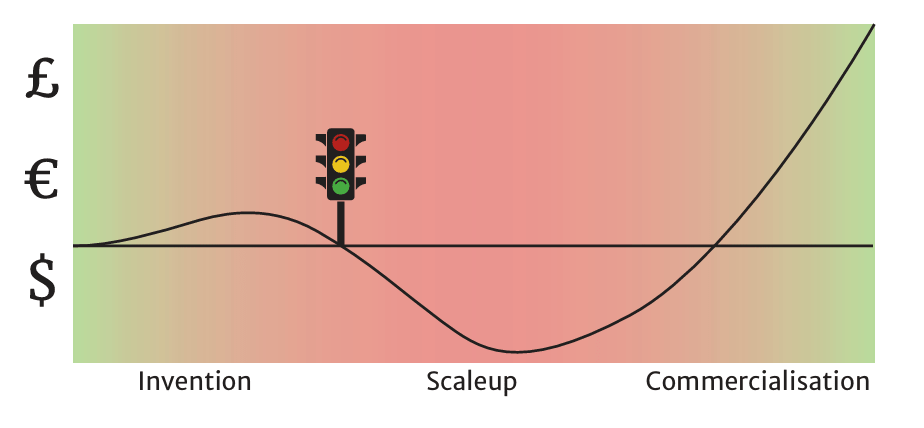
It’s often the tipping point into a region we call “the valley of death”. Universities, innovation grants and small research budgets can often support early experimentation. Pilot plants are different. They require engineering design, process safety reviews, equipment procurement, construction and operations support.
Therefore, this is the point to carry out critical checks before committing to pilot infrastructure.
Three questions worth answering first
Recent Editions
Catch up on the latest news, views and jobs from The Chemical Engineer. Below are the four latest issues. View a wider selection of the archive from within the Magazine section of this site.