Ithaca resubmits plans for UK’s second-largest undeveloped oil field
PLANS for the controversial Cambo offshore oil field in the UK have been resubmitted, as Ithaca Energy seeks approval to develop one of the largest remaining hydrocarbon resources on the UK Continental Shelf.
Believed to contain around 170m bbl of recoverable oil, Ithaca plans to drill nine production wells and a new floating production, storage and offloading vessel (FPSO). Cambo lies 130 km west of the Shetland Islands in water depths of around 1 km. The company hopes to start drilling by the end of 2028 and expects first oil by the end of 2030.
The proposal has been met with concern from environmental groups, under the impression they had successfully campaigned against the project after Shell withdrew its interest in 2021. Keir Starmer also opposed the development before taking office. However, Ithaca said last month that “evolving certainty” in government policy is supporting efforts to secure a new project partner. Final government approval of Cambo is expected to be closely linked to the nearby Rosebank field, in which Ithaca holds a 20% stake.
Over its expected 25-year lifetime, Cambo’s primary product would be oil, with peak production reaching up to 5,876 t/d (approximately 43,000 bbl/d). The FPSO will offload up to 500,000 bbl every two weeks for export by tanker. While Ithaca has not specified destinations, much of the crude is likely to be refined overseas given the UK’s limited refining capacity.
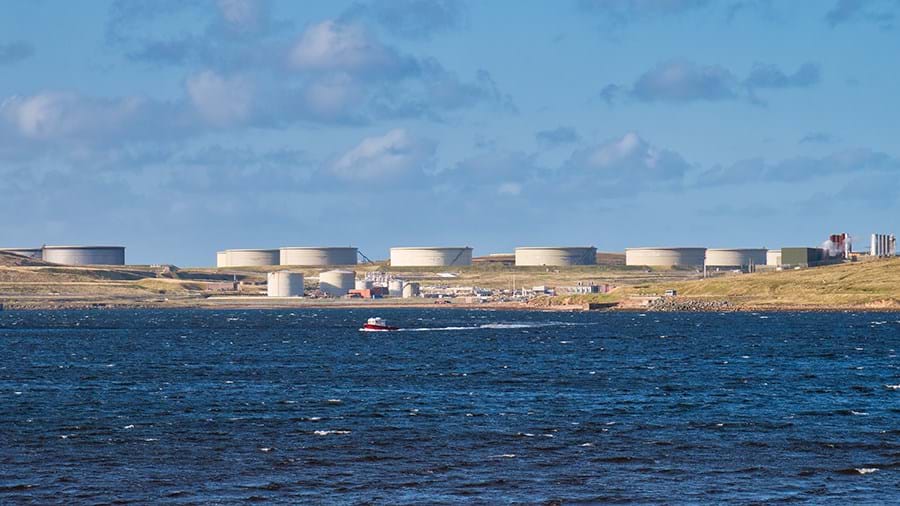
The field will also produce relatively small amounts of gas, peaking at approximately 3,560 boe/d. This would mainly be used to power the FPSO, with excess exported to the Sullom Voe terminal via a new 32.5 km pipeline tied back to the planned Rosebank development. However, the FPSO is expected to require additional fuel supply as early as 2036, at which point the vessel could import gas from Sullom Voe. Ithaca added that the FPSO will be “electrification ready”, allowing potential future connection to offshore renewable power.
Total life-cycle emissions from Cambo, including combustion, are estimated at just over 100m tCO2e – less than Rosebank’s 250m tCO2e but more than the Tornado and Fotla fields combined, for which Ithaca has recently submitted plans. Production emissions from the FPSO alone are expected to exceed 3m tCO2e. Ithaca said the emissions are “not significant” when compared to worldwide levels and argued they are in line with UK and global net zero trajectories.
Elsewhere in the North Sea
Separately, Serica has submitted plans to develop the much smaller Kyla field, located east of Scotland.
The company plans to drill a single production well and lay a new 13.2 km pipeline tying it back to the existing Triton FPSO. Serica plans to have completed drilling by early 2028, with first oil expected later that year.
Kyla has an expected lifetime of eight years, with peak production of approximately 6,800 bbl/d of oil and 850 boe/d of gas.
Recent Editions
Catch up on the latest news, views and jobs from The Chemical Engineer. Below are the four latest issues. View a wider selection of the archive from within the Magazine section of this site.