Teams of Intelligent Agents: The Next Step for Chemical Engineering
Artur Schweidtmann says multi-agent systems can reshape the way engineers design and operate chemical plants – turning AI into collaborative digital teammates rather than replacements
Quick read
- From single AIs to digital teams: Multi-agent systems (MASs) transform isolated models into collaborative AI specialists working together on engineering tasks
- Human-AI partnership: MASs won’t replace engineers but will act as digital teammates, providing transparency, reasoning and support in decision-making
- Challenges ahead: Integration with tools, trustworthy data, transparency and sustainability will define their safe and effective adoption
IMAGINE walking into your office to find that your team already started work. One agent optimised your process simulation overnight. Another has summarised the latest safety reports. A third is balancing economic and environmental objectives in real time. You open a dashboard, review their dialogue, and – like any good supervisor – ask a few probing questions before deciding which proposal to
test next.
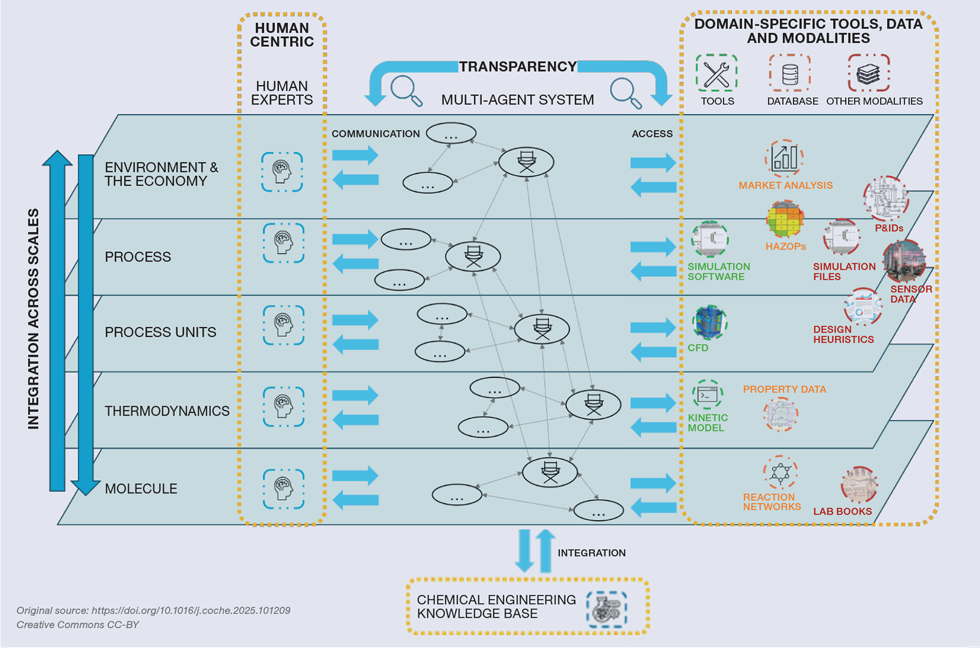
This is not science fiction. It is the emerging world of multi-agent systems (MASs): digital teams of artificial intelligence (AI) agents that collaborate, communicate and reason to solve complex problems. In chemical engineering, this approach could fundamentally change how we design and operate processes. Rather than relying on a single, monolithic AI model – such as a Large Language Model (LLM) – MASs divide intelligence into specialised roles that interact much like human engineering teams.
From individual models to collaborative AI
Engineers already use AI – surrogate models for process optimisation, machine-learning models for fault detection and so on. But these tools are typically narrow and isolated.
A MAS instead acts like a project meeting populated with AI specialists. One agent might be specialised in thermodynamics, another in scheduling and another in sustainability metrics. They debate, critique and build upon each other’s outputs.
Modern frameworks such as LangGraph, crewAI or AutoGen allow agents to converse in natural language, use simulation tools, access databases and consult a human supervisor when necessary.
If LLMs gave us an assistant, MASs promise an entire digital project team – one that can scale, specialise and learn to collaborate.

Multi-agent systems (MASs)
Multi-agent systems (MASs) are distributed systems composed of multiple agents that interact to achieve individual or collective goals. An agent is most generally defined as an entity that perceives its environment and independently executes actions upon the environment on behalf of its owner.
Why chemical engineering is a natural fit
Chemical engineering is inherently multi-scale and multi-disciplinary. We move from molecular design to process synthesis, from control strategies to global supply chains. Our profession works in interdisciplinary teams: process engineers, safety engineers, environmental specialists, economists and operators, all coordinating to achieve collective goals under uncertainty. This makes chemical engineering a natural habitat for multi-agent AI.
Three areas where MASs could transform work:
1. Process design: Agents propose process alternatives. One models thermodynamics. Another optimises heat integration. A third evaluates life-cycle impact. They exchange information automatically and return a ranked list of feasible designs
2. Plant operation: Agents continuously balance product demand, energy consumption and emissions. When a disturbance occurs, a diagnostic agent identifies the cause while a control agent adjusts the setpoints. Their conversation is logged and visible to human operators
3. Process engineering and safety: Agents could co-develop flowsheets, assist in HAZOPs or generate cost estimates by analysing P&IDs and contextual data
Each example reflects a broader shift: from static automation to dynamic human–AI collaboration
A new kind of workflow
Traditional AI tools often operate like calculators: you give input, they give output. MASs, by contrast, think in dialogue. Agents can challenge each other’s conclusions, iterate and self-correct. Beyond potential performance gains, the approach results in greater transparency – every reasoning step is recorded as a conversation thread that engineers can review and interact with.
This mirrors how real engineering decisions are made: through discussion, debate and justification. For instance, a design agent proposing a novel reactor configuration could be questioned by a safety agent – “Does this violate temperature constraints?” – before a supervisor agent compiles the final report. The transcript itself becomes a rich record of decision-making, traceable and auditable.
Our recent prototypes already demonstrate MASs that generate PFDs or perform HAZOP-style reasoning using digital P&IDs. They are early, experimental and imperfect but they hint at what’s coming.
Recent Editions
Catch up on the latest news, views and jobs from The Chemical Engineer. Below are the four latest issues. View a wider selection of the archive from within the Magazine section of this site.