Flooding: the market

Modern flood resilience requires more than just physical barriers, with increasing demand for novel solutions that chemical engineers are already playing a crucial role in developing
Despite the UK having just experienced a long summer drought, climate change experts are predicting more high-intensity rainfall in the UK over the coming years – and, subsequently, a greater risk of severe floods.
As recently as January 2026, parts of Northern Ireland, eastern Scotland and southwest England experienced record rainfall, leading in some parts to devastating floods. During that January deluge, climate change expert Professor Hayley Fowler of Newcastle University suggested that the changes we’ve seen to winter rainfall are already 20 years ahead of what climate models predicted for the UK.
Environment Agency figures, updated in August 2026, show 6.3m properties in the UK at risk from flooding, a figure projected to rise to more than 7m by the middle of the century. In July 2026, experts from the University of Bristol warned that up to 13m people face a long-term risk of coastal flooding as sea levels rise. As floods become more frequent, erratic and volatile, flood resilience measures have to adapt.
What is flood resilience today?
Flood resilience is seeing a shift in priorities. “It’s consequence reduction, not just hazard control,” says Dr Steven Forrest, a flood resilience expert from the University of Hull who runs an MSc in flood risk management. “We have to think about where the water ends up, not just about keeping it away. Physically building structures is still very useful, but structures can fail … they weren’t built for the conditions we’re now facing.”
For Forrest, climate-induced changes mean it is increasingly difficult for flood resilience teams to predict when it will flood, how often, where, how much land will be affected, and how much damage will be caused.
“When there’s a large amount of water from a different source entering a settlement or rural area, we need to think about the land itself, where the water is going to land, what measures people can take to reduce damage, and how to recover afterwards,” he says.
Nature-based solutions
Given the government’s preference for nature-based approaches to flood resilience, it’s likely that the role of chemical engineers in flood resilience will become more important.
In May 2026, a Parliamentary Office of Science and Technology report noted that nature-based solutions (NBS) can improve flood resilience if “based on a granular understanding of what affects resilience in the specific catchment area”. NBS, it argued, can reduce flood peaks, slow the flow of water and improve water storage, reducing both flood and drought risk.
The Environment Agency describes nature-based solutions as “actions that re-establish natural processes that increase resilience to flood and drought”, and which “aim to temporarily store overland runoff and slow flows through the river system”.
Downstream dilemmas
There is one problem when encouraging water to spread out that, while not making nature-based flood systems a bad idea, does make the role of chemical engineers in designing them more important than ever.
“When there’s a flood we need to think about what the water is going to carry with it,” Forrest says.
A report published earlier this year warned that flood prevention schemes built through historic landfill sites risk releasing toxic chemicals into their local environment. The ENDS report analysis focused on the River Thames Scheme in Surrey, where two channels will be dug through a site now known to contain toxic chemicals. It showed that 1,287 of the 21,000 historic landfills across England and Wales contain hazardous waste, and possibly more as Environment Agency records are incomplete.
Lead, arsenic and cyanide can remain in soil for decades or in deep-water lakes under or near to historical landfill sites, which are usually disused gravel pits or clay quarries. Flood waters can release these chemicals into watercourses and even into people’s homes.
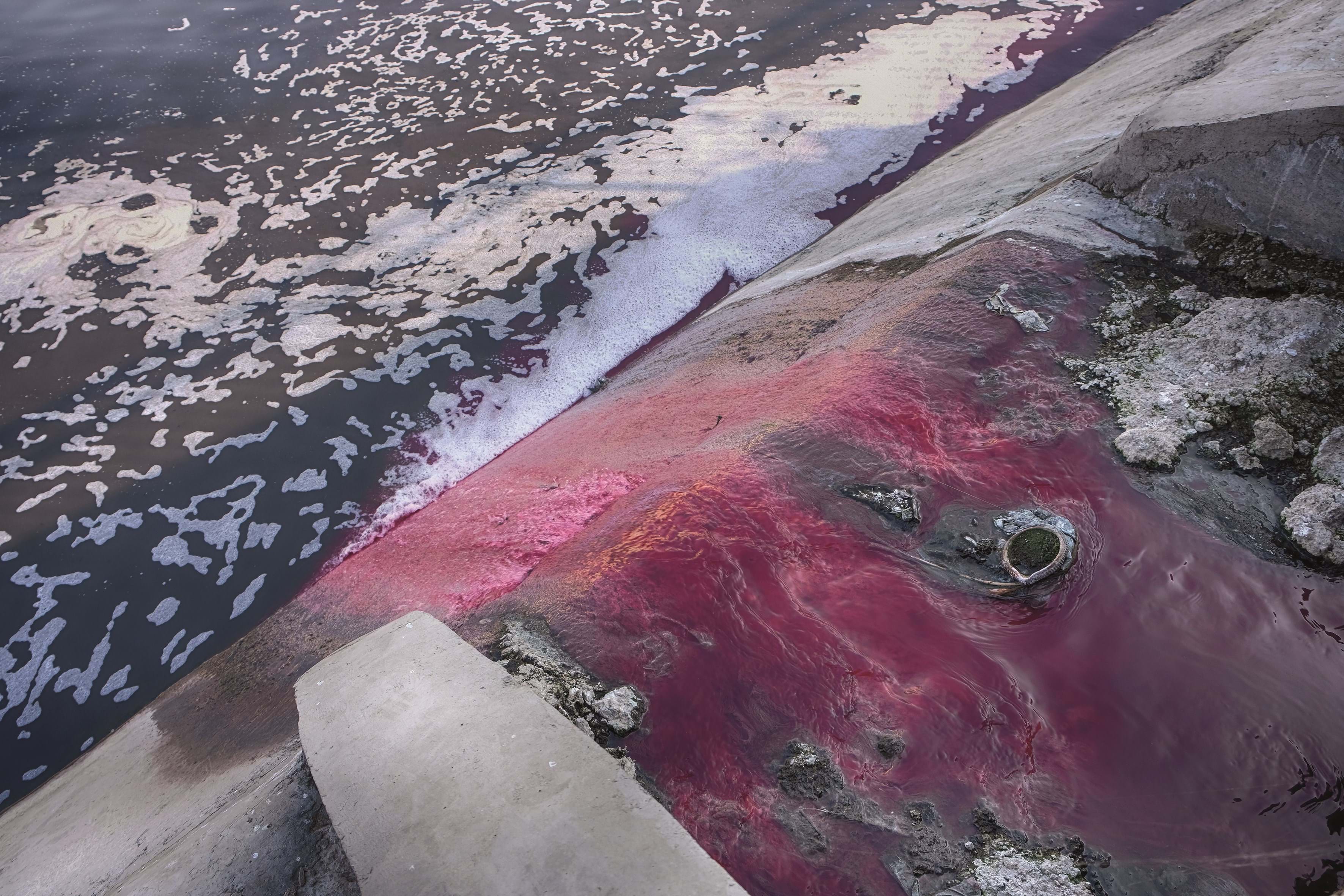
And it’s not just deep-water lakes and historical landfills that contain toxic chemicals. In August, an Environment Agency report found that all of Britain’s rivers and lakes are polluted with chemicals due to the buildup over time of heavy metals and the ‘forever chemicals’ used in thousands of products from frying pans to carpets.
A significant polluter is phosphate, a nutrient from sewage and farm runoff, while other toxic chemicals come from petrol, pesticides and road runoff. Eutrophication, where a body of water becomes overly enriched with nutrients – mostly nitrogen and phosphorus as a result of intensive farming practices – is also an issue.
Fighting back the floods
University of Birmingham's pollutants reduction technique
Activity
Dyes from textiles, cosmetics, food, pharmaceuticals and printing are a major contributor to water pollution worldwide. To accelerate the decomposition of these chemicals in contaminated water, the Birmingham researchers used photocatalysis to accelerate a chemical reaction using light and a catalyst.
Project
The idea is that when light hits the catalyst, it creates electron-hole pairs that form reactive radicals. These radicals break down pollutants, split water into clean hydrogen fuel, or drive chemical synthesis without consuming the catalyst itself.
However, rather than use toxic catalytic materials, which create an additional waste stream, the Birmingham researchers, led by Jason Stafford, associate professor in the Department of Mechnical Engineering, have designed a water-based method to degrade pollutants to simpler, non-toxic compounds.
The process uses high-intensity turbulent shear stresses to exfoliate molecular-thin sheets of material. These individual sheets are then layered together to form a brand-new composite structure made of two different semiconductor materials with photoelectronic properties.
To make the catalysts, the research team chose graphitic carbon nitride and molybdenum disulfide – compounds known for visible-light responsiveness, high stability and low cost, making them ideal for solar-to-chemical energy conversion. Separating the material into ultra-thin sheets dramatically improves how the material interacts with light and chemicals.
The researchers tested the catalysts using indigo carmine, rhodamine b and acid red 266 – synthetic chemicals used in textile dyeing, industrial processes or biotechnology research. Acid red 266 also contains carbon-fluorine bonds. The study demonstrated that the molecular-thin catalysts increased the degradation performance on test pollutants by up to 2.5 times compared to the same chemical ingredients in their standard, bulk form as chalk-like powders.
Researchers are confident that the method could be used to produce photocatalysts at an industrial scale. But efforts are also being made to remove pollutants from the abandoned mines, subterranean lakes and historic landfill sites themselves.

Wigen’s precipitation, ultrafiltration and industrial reverse osmosis arrays
Activity
US company Wigen’s treatment system removes toxic chemicals that could seep into water systems during a flood, with chemical precipitation converting dissolved hazardous contaminants into solid particles that can be physically filtered out of the water.
Process
The system injects alkaline chemicals – lime or sodium hydroxide – into the acidic underground water, raising its pH level and causing dissolved heavy metals to form solids.
Pressurised vessels containing bundles of hollow-fibre membrane strands with microscopic pores (ultrafiltration) strain out the remaining particulate matter – tiny solid pieces – from the water.
Industrial reverse osmosis arrays use a high-pressure molecular-level filtration process to counteract natural osmosis pressures, and remove dissolved ions, salts and trace minerals from water.
Leachate is the liquid that forms when water seeps through waste in a landfill and picks up dissolved or suspended chemicals, heavy metals or toxins. To remove from the water, Wigen uses multi-media pressure filters – large, pressurised steel vessels with different filtration media – arranged in layers by density and size.
When water containing landfill leachate flows in, the coarse granules at the top trap the largest debris. As the water moves deeper, the layers become progressively tighter and finer, trapping smaller and smaller particles.
Granular activated carbon absorbers are polishing filters packed with millions of tiny, porous carbon granules. When the leachate enters the top of the GAC column, dissolved toxic chemicals, industrial solvents and organic pollutants are attracted to the carbon and get stuck in the microscopic pores.

Pilkington’s glass panel protection
Activity
Flood-resistant laminated glass is being used on the Environment Agency’s Flood Risk Management Scheme in Kendal. Storm Desmond in December 2015 saw record-breaking rainfall across Cumbria. In Kendal, 2,276 properties suffered significant impacts.
Process
The Environment Agency is developing a system of stone-clad walls and embankments to protect the area. Glass panels have been added to the system, to maintain views of Kendal’s historic town centre. The laminated Pilkington glass is made of two or more layers bonded by a transparent interlayer, needed because standard glass alone would shatter when a river surges.
Manufacturer Kuraray engineered a laminated interlayer made from ionoplast polymer, a substance that makes the layer stronger and stiffer than standard PVB materials.
These properties allow the glass panel to remain perfectly rigid and load-bearing, even if the outer glass panes break.
The interlayer also has an ethylene-methacrylic acid copolymer base mixed with specialised sodium or zinc salts, stopping the edges from delaminating or clouding despite being continuously exposed to river moisture.
Chemical engineers' role
“Chemical engineers are central to designing, scaling and optimising the technological solutions needed to treat the widespread phosphate, sewage and chemical pollution,” says Fiona McLeod, professor of process safety at the University of Sheffield and CTO at IChemE’s Safety Centre.
Forrest agrees. “We need experts who can measure the types of risk we’ll face, who identify the problem but also consider how to engineer it, and alter it so chemical processes don’t cause the problems when it does flood.” One such role could be the development of “permeable roads and surfaces that prevent the pooling of water and localised flooding; these could also be designed in collaboration with hydrologists and social scientists”.
Guga Gugaratshan, business development director for process solutions with global engineering firm HBK, adds that chemical engineers bring valuable operational capabilities that allow them to “work on flow, transport process, water treatment and contamination control and on surface and underground, and the effect of any chemical spill on a flood”.
According to Alberto Diaz, from the Department of Chemical Engineering at the Universidad Autónoma de Madrid, chemical engineers are essential to the creation of processes and infrastructure that can adapt to a changing climate.
“Technologies such as rainwater harvesting, desalination and wastewater treatment systems play a critical role in ensuring a reliable water supply, while green infrastructure such as permeable pavements and green roofs can help manage stormwater and reduce flooding risks,”
Diaz wrote in the American Journal of Chemistry and Chemical Engineering. Diaz suggests that chemical engineers can support flood resilience by using advanced computational modelling to simulate the impact of climate change on buildings and systems. And they can certainly play a major role in the building of climate-resilient infrastructure with concrete, recycled steel and eco-friendly insulation in all parts of modern flood resilience systems.
Take chemically-treated permeable pavements, which could stop toxic runoff from entering the water table. Flood barriers can also contain absorbent polymers, waterproof coatings and microbial self-healing concrete.
Next steps
Protecting the UK from flooding is no longer a basic “dykes and dams” exercise. Modern flood resilience is a much wider operation in which chemical engineers can play a crucial part.
“Flooding is going to get worse, and there’ll be greater demand for specialist skills from non-traditional fields,” Forrest says.
Increasingly, flood resilience systems will be designed by multi-disciplinary teams, with chemical engineers playing their part. Cross-sector collaboration will be key.
Recent Editions
Catch up on the latest news, views and jobs from The Chemical Engineer. Below are the four latest issues. View a wider selection of the archive from within the Magazine section of this site.