Viewpoint: How Solid Oxide Technology Could Reshape Clean Power
Phil Caldwell, CEO of Ceres Power, outlines how solid oxide fuel cells could provide efficient, low-carbon power for industry while remaining compatible with future fuels such as hydrogen
Quick read
- Beyond renewables alone: Rising electricity demand and grid constraints are driving interest in high-efficiency, onsite power technologies
- Why solid oxide stands out: SOFCs can run on natural gas or hydrogen, offering high efficiency, fuel flexibility and lower emissions
- A bridge to net zero: Deployed today, solid oxide systems could support industrial decarbonisation while remaining adaptable to future energy systems
THE GLOBAL move towards electrification is well underway, but it remains chronically underpowered. While governments set ambitious targets to replace fossil-fuel-based grid generation with renewables, electricity demand is rising sharply, driven by industrialisation and the rapid growth of applications such as AI data centres alongside wider industrial and commercial demand.
Renewables supply around 20% of the world’s total energy1 and about 40% of global electricity generation.2 China leads the charge, accounting for nearly a third of global clean energy investment,3 more than the US and Europe combined. Even so, the gap remains significant. To fully replace fossil fuels by mid-century, the International Energy Agency suggests that annual clean energy investment must rise to US$4.5tn per year by 2030,4 requiring unprecedented commitments from nations and industry alike.
Against this backdrop, attention is turning to technologies that can deliver low-carbon power directly at the point of use, easing pressure on overstretched grids. One option gaining traction is stationary fuel cells, particularly solid oxide fuel cells (SOFCs), which can generate electricity directly from gaseous fuels without combustion.
Why fuel cells matter
Fuel cells are electrochemical devices that extract chemical energy from gaseous fuel directly as electrical energy. This has the advantage of higher efficiency than the traditional approach of burning fuel and then generating electricity via conventional combustion engines or turbines, leading to inevitable losses of chemical energy as heat.
There are three principal fuel cell types: Alkaline Fuel Cells (AFC), Proton Exchange Membrane (PEM), and Solid Oxide Fuel Cells (SOFCs).
While fuel cells have long been used in space and, more recently, transport, only now are they seeing wider deployment for stationary power, where industries need reliable, low-carbon generation.
Technologies such as PEM and Alkaline operate at low temperatures, requiring high-purity hydrogen and precious-metal catalysts to increase activity. Voltage losses are higher and more energy is lost as resistance and heat, which must be actively removed to maintain operating conditions, ultimately limiting system efficiency.
The main advantage of SOFCs is that they can run on several types of fuel. They work well with hydrogen, but also with common fuels like natural gas or hydrogen carriers such as methanol and ammonia. This makes them more versatile than lower temperature fuel cells, which can be more susceptible to poisoning. It also makes them an excellent transitional technology – able to use natural gas today and move to low/zero carbon fuels in the future.
SOFCs operate at high temperatures, which boosts efficiency by speeding up reactions, improving material conductivity, enhancing catalyst performance, reducing voltage losses, and allowing gases to flow more easily. Crucially, the heat generated by the electrochemical reaction can be retained and reused within the system, further improving overall efficiency.
The high operating temperature of SOFCs eliminates the need for precious-metal catalysts, as base metals like nickel provide sufficient catalytic activity. When using hydrocarbon fuels, they emit around 25% less CO2 compared to open cycle gas turbines and the exhaust stream contains concentrated CO2, which makes capturing carbon and reducing emissions easier.
Commercialising SOFCs
Early SOFCs, prototyped in the 1960s, were all-ceramic systems operating at very high temperatures. They required expensive alloys, complex sealing and careful thermal management and were vulnerable to mechanical stress or fuel interruptions – challenges that slowed commercial deployment.
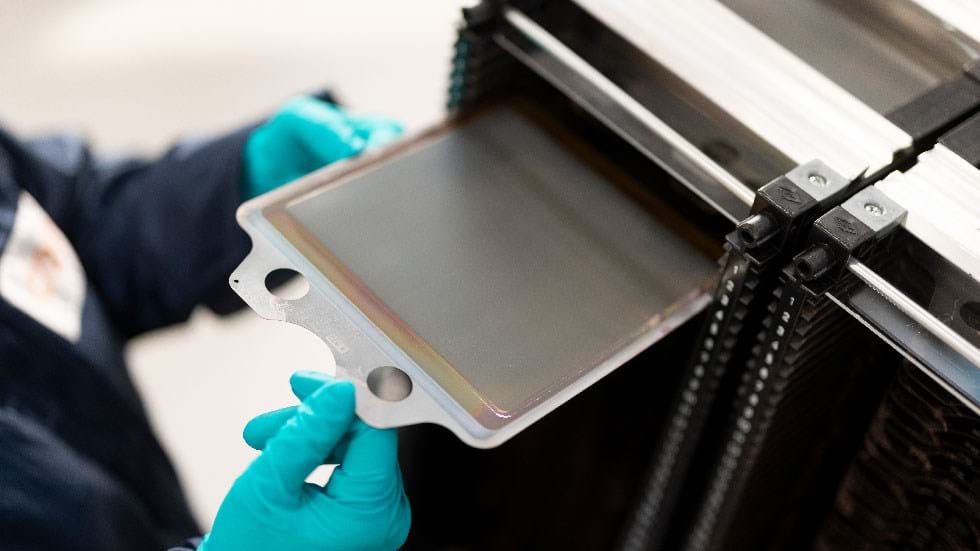
Recent developments aim to address these limitations. At Ceres, building on research originating from Imperial College London, we have developed a metal-supported solid oxide cell that operates at lower temperatures, typically between 450°C and 630°C. Replacing ceramic substrates with ferritic stainless steel improves mechanical robustness and allows components to be laser-welded into stacks.
The use of steel throughout the stack reduces material costs and improves tolerance to fuel interruptions, making the technology better suited to real-world industrial operation.
Systems based on this approach are now being deployed that can generate electricity from natural gas with net electrical efficiencies of around 65%. They also produce waste heat at temperatures over 300°C, which can be captured for combined heat and power applications, improving overall system efficiency to more than 90%. One further advantage is reversibility: the same platform can operate as either a fuel cell or as an electrolyser, efficiently producing hydrogen or power as required – offering manufacturers access to multiple markets with one investment.
Industrial interest
Rather than manufacturing systems itself, Ceres licenses its technology to industrial partners. Companies including Weichai in China, Doosan in South Korea and Delta in Taiwan are developing SOFC systems using the metal-supported design. Doosan began production in the summer of 2025 at a facility with capacity to manufacture 50 MW of systems annually.
These systems are primarily targeted at industrial sites, commercial buildings and data centres, where demand for reliable, low-carbon power is growing and grid capacity constraints are becoming more acute.
A role in the energy transition?
Other distributed power technologies – including reciprocating engines, microturbines and alternative fuel cell chemistries – are also competing for industrial decarbonisation markets.
Solid oxide technology could act as a bridge in the energy transition, delivering high-efficiency power from natural gas today while remaining compatible with hydrogen and other low-carbon fuels as they become available.
To make a material impact, SOFCs will need to scale quickly and that depends on manufacturing capacity coming on stream, cost reduction and policy support. However, as policymakers and industry confront rising electricity demand, grid constraints and the limits of renewables deployment, distributed technologies that combine efficiency, flexibility and fuel optionality are attracting renewed interest.
In that context, solid oxide systems illustrate how clean power could shift from a centralised challenge to a distributed opportunity – enabling energy-intensive industries to secure reliable, low-carbon power while easing pressure on the grid.
References
1. IEA global overview – Renewables 2024: bit.ly/global-overview-2024
2. IEA Global Energy Review 2025: www.iea.org/reports/global-energy-review-2025
3. IEA World Energy Investment 2024- China: bit.ly/energy-investment-china
4. IEA: Net Zero Roadmap: A Global Pathway to Keep the 1.5 °C Goal in Reach: bit.ly/iea-global-pathway
Recent Editions
Catch up on the latest news, views and jobs from The Chemical Engineer. Below are the four latest issues. View a wider selection of the archive from within the Magazine section of this site.