Two Decades After Buncefield, Leadership Remains the True Safety System
Twenty years after Buncefield, all original signatories to the Process Safety Leadership Principles signed again. Gus Carroll explains why this continuity of commitment matters more than ever
IN 2025, history came full circle. Twenty years after Buncefield – Europe’s largest peacetime explosion – the COMAH (Control of Major Accident Hazards) Strategic Forum reaffirmed its commitment to process safety by reissuing the eight Process Safety Leadership Principles. Every original signatory signed again.
That continuity tells us something: leadership in process safety isn’t a trend, it’s a permanent responsibility. Two decades on, the lesson from Buncefield remains clear: major accidents don’t announce themselves. And when it comes to prevention, leadership, not systems or technology, is the critical factor.
This matters urgently because UK industry faces a transition that makes the principles more critical than ever. As 89,000 skilled roles disappear from traditional COMAH sectors and new industries emerge, the question isn’t whether we have the right equipment or procedures. It’s whether we have leaders who understand that process safety is a cultural imperative, not a compliance exercise.
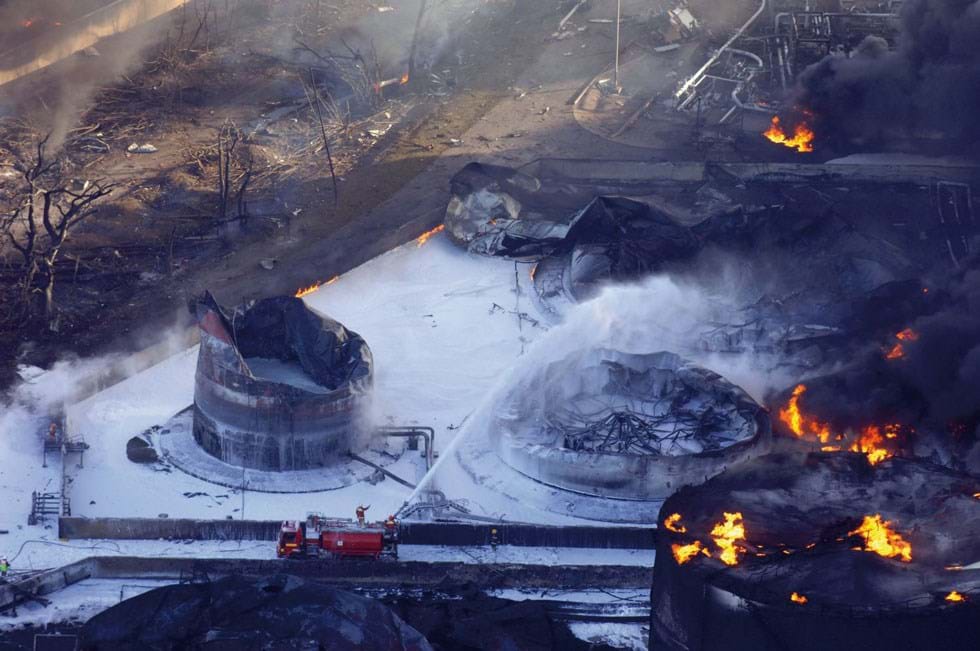
Buncefield
The 2005 Buncefield fire was the biggest industrial explosion in the UK since 1974. The incident caused an oil storage depot in Hemel Hempstead to burn for four days, injuring 43 people.
What the data reveals
The COMAH Strategic Forum (CSF) has privileged access to concerning data. Over a three-year period, the Health and Safety Executive (HSE) conducted over 30 process safety leadership interventions across UK industry. Industry body Step Change in Safety surveyed more than 90 oil and gas operators. The picture revealed is troubling.
Senior leaders demonstrate awareness of major accident hazard responsibilities. Regular risk reviews occur. Process safety indicators exist. But beneath this veneer lies a fundamental problem: we have commitment without capability development.
Leadership capability development relies on individual initiative rather than systematic processes. Structured process safety training and competency frameworks for senior leadership are largely absent. Companies remain reluctant to share learnings broadly. There’s over-reliance on HSE inspections rather than robust internal audit.1
We have awareness but not deep expertise. We have indicators but not always insight. We have leaders who know they’re responsible but haven’t been systematically developed to discharge that responsibility. This is precisely why the Process Safety Leadership Group published the second edition of its guide to leadership – because good intentions without systematic capability development is a recipe for the next major accident.

The emerging sector gap
Traditional COMAH sectors are declining. Emerging sectors are rising: hydrogen, batteries, carbon capture, small modular reactors, biofuels and sustainable aviation fuels. The physics hasn’t changed. The chemistry hasn’t changed. But here’s the critical difference: traditional sectors developed process safety culture through decades of hard-won experience. Leaders absorbed process safety thinking through organisational osmosis – through seeing systems succeed and critically, fail.
Emerging sectors lack this luxury. From what I’ve seen and heard, they’re attracting leaders without deep process safety backgrounds who view major hazard management as compliance rather than culture. Leaders who lack institutional memory of what happens when process safety becomes secondary to production targets or cost reduction.
The re-signing signals that experienced leaders recognise the enduring truth: visible, committed, knowledgeable leadership is the single most critical factor in preventing major accidents. Without it, even the most sophisticated safety systems become expensive decorations.
The eight principles in practice
The principles aren’t abstract aspirations. They distinguish organisations with robust process safety cultures from those paying lip service. Leaders must provide visible process safety leadership – not delegated, not assumed, but visible where workers see senior management actively engaged. They must establish clear expectations, ensuring everyone understands principles, not just procedures.
Leaders must ensure sufficient competency and resources, recognising capability gaps create accident opportunities. They must foster cultures where people raise concerns without fear. They must ensure effective systems for identifying hazards throughout asset life cycles, effective learning from incidents, operating discipline through procedure adherence and stakeholder engagement beyond facility boundaries.
These principles, freely available through the Process Safety Forum website alongside the second edition leadership guide, represent decades of accumulated wisdom. Yet their value depends entirely on implementation. Documents don’t save lives. Leadership does.
The capability-leadership nexus
Between 2025 and 2035, 89,000 skilled roles will disappear from the UK workforce, with most not absorbed by emerging industries. This isn’t just a statistic – it’s a leadership continuity crisis. A CSF Capability Working Group survey revealed gaps that, without leadership intervention, will become chasms.
Twenty years of experience cannot be created in training courses. Institutional memory must be deliberately preserved through leadership commitment. Yet competency development remains reliant on individual initiative rather than systematic processes mandated by leadership.
The CSF’s Natech work – bow tie analyses for climate-driven events affecting facilities – exists because leaders recognised emerging risk and committed resources systematically. Similarly, improved emergency response guidance emerged because leaders understood importance and allocated resources. But guidance achieves nothing without leaders who implement it as living practice rather than filed documents.
What leaders must do
The re-signing isn’t symbolic – it’s a call demanding specific responses. Leaders in traditional sectors must systematically transfer knowledge through structured programmes documenting not just procedures but reasoning. Leaders in emerging sectors must resist viewing their technologies as so novel that established principles don’t apply. Hydrogen follows physics. Batteries follow chemistry. Process safety principles apply universally.
Leaders at all levels must build capability systematically: establishing competency frameworks, making training mandatory, prioritising process safety understanding in succession planning, creating cultures where process safety leadership is recognised and rewarded.
The question demanding an answer
Recent Editions
Catch up on the latest news, views and jobs from The Chemical Engineer. Below are the four latest issues. View a wider selection of the archive from within the Magazine section of this site.