Chemical Recycling of PVC: From Laboratory Promise to Industrial Reality
Rajendra Gupta explores why PVC’s chlorine-rich chemistry makes recycling uniquely difficult – and what must change to move chemical recycling from pilots to industrial scale
Quick read
- PVC chemistry limits recyclability: High chlorine content and diverse additives make PVC difficult to process, leading to corrosion, contamination and downgraded recyclate
- Chemical methods remain hard to scale: Gasification, dechlorination and pyrolysis work in the lab but face major technical and economic barriers at commercial scale
- Industrial progress needs coordinated action: Advancing PVC recycling requires efficient chlorine recovery, corrosion-resistant designs, long-term pilots and supportive policy frameworks
DURING an industry conference, I spoke with a plant manager from a PVC recycling facility who shared an insight that reinforced much of what I had been studying. Despite processing several tonnes of material each day, his plant can only accept specific, cleaner grades of PVC – mainly rigid, unplasticised streams from construction waste and industrial scrap.
“We turn away more than we process,” he told me. “Flexible and mixed PVC just creates too many problems, the chlorine and additives make everything complicated.”
That conversation summed up the central challenge: PVC’s complex chemistry and diverse formulations make large-scale recycling technically possible, but operationally difficult.
The growing PVC challenge
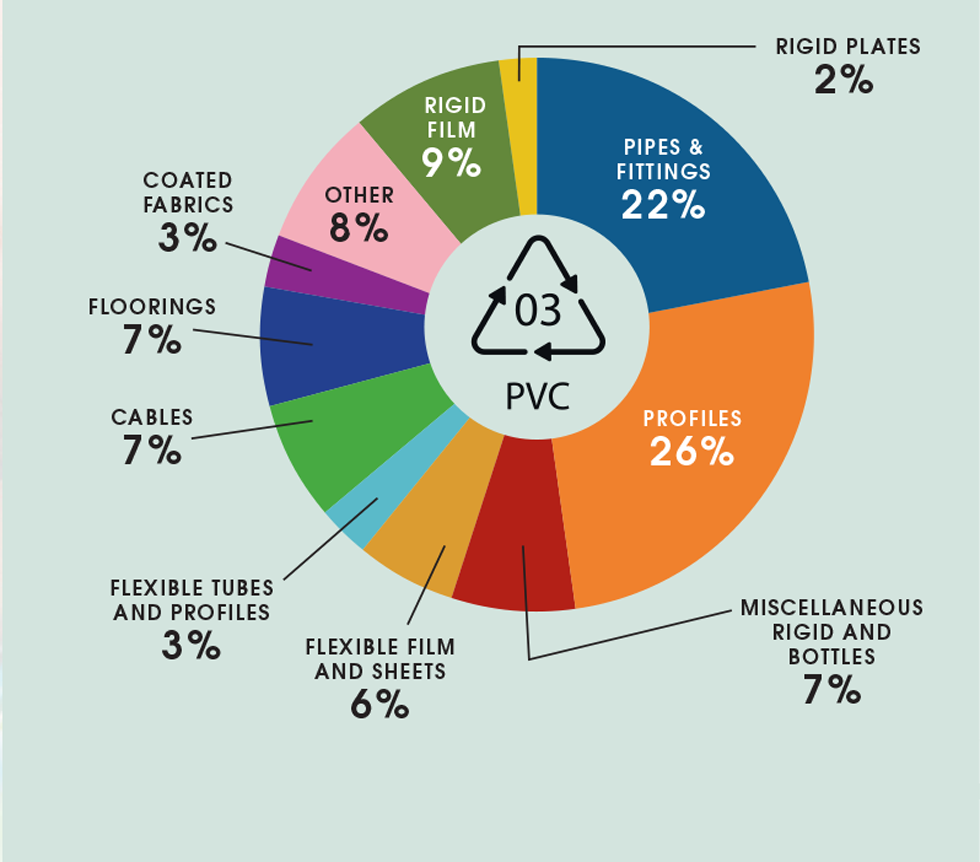
Polyvinyl chloride (PVC) is a versatile polymer used across countless applications, with global demand set to rise steadily through 2030, increasing by roughly 4.8% each year.1 Its production depends on chlorine gas and ethylene – the latter primarily derived from fossil fuels – meaning continued growth will drive further fossil resource extraction. Despite its extensive use, only a small fraction of PVC waste is recycled. Most ends up in landfill or the wider environment. Current projections indicate that by 2032, only about 1.2% of total PVC produced will be recycled, highlighting a significant gap in sustainable material management.
Europe’s role in advancing PVC recycling
Europe has taken the lead in addressing this challenge. In 2000, the European PVC industry launched Vinyl 2010, a voluntary commitment bringing together producers, converters and recyclers to enhance recycling infrastructure, phase out hazardous additives and promote the use of recycled PVC. The successor programme, VinylPlus, continues that work. According to its 2024 report, Europe now collectively recycles approximately 0.8m t/y of PVC.2 However, achieving higher global recycling rates requires commercial-scale PVC recycling plants capable of processing complex waste streams. During my research visits to pilot facilities, I have often heard the same refrain: “It works in the lab, but scaling up is a different beast entirely.”

Why mechanical recycling falls short
Mechanical recycling – grinding, melting and reforming – works well for relatively pure plastic streams but PVC presents unique obstacles. Additives such as plasticisers, stabilisers and UV protectors, combined with multilayer products and contamination, lead to downgraded recyclate unsuitable for many original applications. Case studies show mechanically recycled PVC samples that are discoloured, brittle or structurally compromised.
This is where chemical recycling enters the picture, breaking PVC down to molecular components and rebuilding it or converting it into valuable chemicals. Three main approaches are being explored: gasification, dechlorination and pyrolysis.
GASIFICATION
Gasification is a thermochemical recycling process in which PVC waste is partially oxidised at elevated temperatures of 800–1,100°C in the presence of a limited oxygen supply. The primary product is syngas – a mixture of carbon monoxide and hydrogen – which can be used as a clean fuel or as a feedstock for chemicals such as methanol and ammonia. Smaller quantities of CO2 are also produced, along with trace amounts of methane and other light hydrocarbons.
Researchers are focused on improving the efficiency of PVC gasification. Approaches include molten salt gasification to enhance heat transfer and capture chlorine, calcium-based additives to promote chlorine removal and reduce corrosive byproducts, and nickel-loaded activated carbon catalysts to increase conversion rates and improve syngas quality.
PYROLYSIS
Pyrolysis – the thermal decomposition of PVC in the absence of oxygen – generates liquid oils, gases and char. While pyrolysis works well for many plastics, PVC’s chlorine content (around 56% by weight) creates significant obstacles. The HCl produced is highly corrosive, while chlorinated hydrocarbons contaminate the pyrolysis oil.
As a result, no commercial-scale pyrolysis plants currently process PVC as a primary feedstock. Most pyrolysis facilities actively exclude PVC from mixed plastic waste streams to avoid contamination and equipment damage.
DECHLORINATION
Among emerging solutions, dechlorination is increasingly seen as a critical enabler rather than a standalone recycling pathway. Its primary function is to selectively remove chlorine from the polymer backbone prior to high-temperature cracking, thereby mitigating corrosion, reducing the formation of toxic chlorinated byproducts, and improving overall process stability.
Thermal dechlorination involves heating PVC to temperatures at which hydrogen chloride (HCl) is released before extensive polymer chain scission occurs. The resulting dechlorinated polymer residue can then be more effectively processed to produce hydrocarbons, syngas or chemical intermediates.
In some emerging configurations, hydrogen is introduced during or after dechlorination to stabilise reaction intermediates and enhance hydrocarbon yields. Effective chlorine removal at this stage is widely recognised as one of the most important determinants of downstream process reliability and product quality.

The common challenges: Why chlorine complicates recycling
Recent Editions
Catch up on the latest news, views and jobs from The Chemical Engineer. Below are the four latest issues. View a wider selection of the archive from within the Magazine section of this site.