Why the AI era demands we treat algorithms like interns
Following June’s ESCAPE36 conference, Mo Zandi, Eleni Routoula and Michaela Pollock argue that we must now confront a fundamental reality. As AI accelerates across the chemical and process industries, technology is only half the battle: true success will lie in human governance, critical thinking and professional input
We can all agree that artificial intelligence (AI) is no longer a distant prospect on the industrial horizon; it has officially arrived.
For those of us who attended the recent 36th European Symposium on Computer-Aided Process Engineering (ESCAPE36) in Sheffield, this reality was impossible to miss. The conference halls buzzed with an unprecedented energy, driven by researchers, educators and practitioners demonstrating groundbreaking AI tools designed to optimise, simulate and control complex chemical engineering systems.
Of the more than 500 submissions of oral and poster presentations, just under 100 mentioned work and outputs relevant to or assisted by AI (generative AI, large language models, machine learning, agent-based modelling). Notably, of the two sessions devoted to education, knowledge transfer and entrepreneurship, one was focused on AI in chemical engineering education.
From deep learning models predicting molecular properties to generative frameworks streamlining plant design, our discipline is undergoing an extraordinary digital acceleration. Yet amid the excitement of algorithmic breakthroughs, an underlying tension remains. As we hand over more cognitive heavy lifting to autonomous systems, a vital question emerges: how do we responsibly govern these tools without losing the human intuition that safeguards our processes? The answer requires looking beyond the code. As we have argued previously1 regarding the cultural and ethical dimensions of digitalisation, the greatest challenges in adopting AI are rarely just technical; they are deeply tied to human trust, data integrity and oversight.
In the age of AI, human input is not becoming obsolete; it is the definitive bottleneck of operational safety and success. This argument was elaborated on during the latest ChemEngDayUK conference in Birmingham. Panellists from academia and industry argued that AI posed many opportunities for the development of graduates and the industry, in different directions, assuming the long-standing engineering fundamentals are still taught to a high extent.2
Bounded intelligence vs human wisdom
During his keynote at ESCAPE36, process systems engineering pioneer George Stephanopoulos offered a precise definition for our current technological milestone. His view was that “the intelligence of an AI agent is the regulated optimal control behaviour of the AI agent”.
This is a profound insight. It reminds us that no matter how sophisticated a neural network or a large language model appears to be, its “intelligence” is ultimately an algorithmic boundary; a highly advanced optimisation loop confined by mathematics and historical data. It can find patterns and achieve optimal control within its mathematical parameters, but it lacks genuine comprehension.
Because of this boundary, a necessary counterweight to the definition of the intelligence of AI must be proposed: the intelligence of any AI-powered system is ultimately the wisdom of its human user.
An AI tool is only as smart as the data it is trained on, the prompts it is given, and – most importantly – the human capacity to interpret, challenge and validate its output. If we treat AI as an infallible oracle, we invite disaster. Instead, we need a better mental model for how engineers should interact with these technologies and how much they should rely on them. We need to treat AI like our intern.
Amid the excitement of algorithmic breakthroughs, and underlying tension remains
The machine as intern
Think about how you manage a brilliant but inexperienced engineering intern. You welcome their enthusiasm, and you gladly delegate time-consuming tasks to them – whether that is parsing massive datasets, running repetitive simulation permutations or drafting initial process flow sheets. They significantly accelerate your workflow.
However, you would never hand an intern the keys to a high-hazard chemical plant and walk away. You wouldn’t sign off on a P&ID they generated without checking it unit by unit. You maintain rigorous human oversight, provide continuous feedback and closely supervise their decisions.
Why? Because an intern lacks the tacit knowledge, real-world experience and fundamental intuition to recognise when a solution is mathematically elegant but physically hazardous.
AI behaves exactly like this intern. It can generate solutions at blistering speeds, but it is entirely capable of “hallucinating” chemical structures or extrapolating dangerously outside its training data. Most deceptively, it will attempt to optimise a process by focusing intensely on a narrow mechanistic model, remaining completely blind to the broader, systemic risks or external factors that exist outside the mathematics.
If we don’t actively manage this “digital intern”, we risk catastrophic failures. However, to successfully audit a digital intern’s work, the supervisor must be the true expert in the room.
Prerequisites of supervision
sTo spot an error in an AI-generated mass balance, you must instinctively know where the mass must go.
To question an AI’s optimised temperature profile for a highly exothermic reaction, you must have a flawless grasp of chemical kinetics and thermodynamics. To identify when a machine learning model is violating physical laws in a multi-phase flow simulation, a rock-solid foundation in transport phenomena is non-negotiable. To ensure a process is designed as safely as
possible, conducting a rigorous safety analysis with input from the process engineering team rather than relying on AI-generated drafts is fundamental.
Without rigorous grounding in the fundamentals to evaluate the AI outputs critically, the engineer is no longer a supervisor; they are a passive observer. They become entirely dependent on the black box, unable to diagnose when the machine’s “regulated optimal control” is steering the process towards failure.
The next educational paradigm
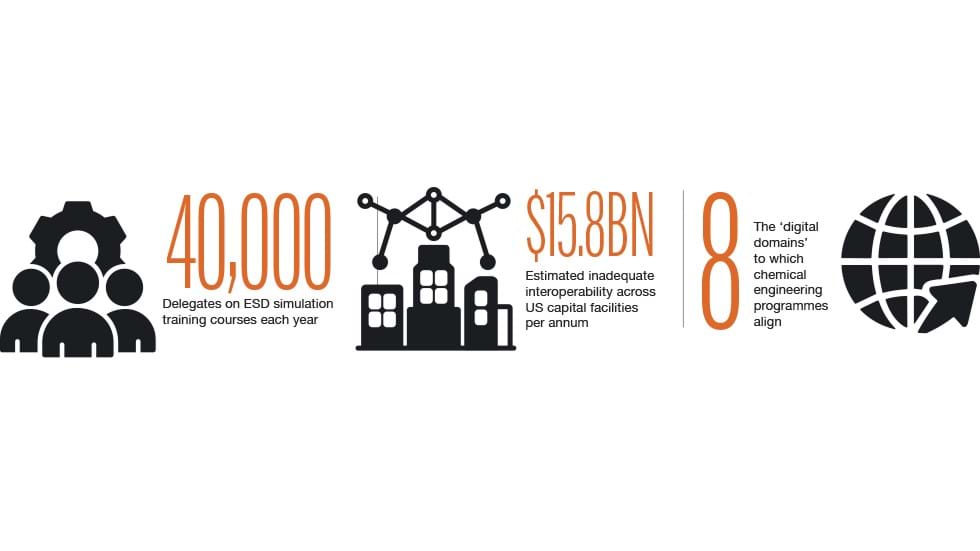
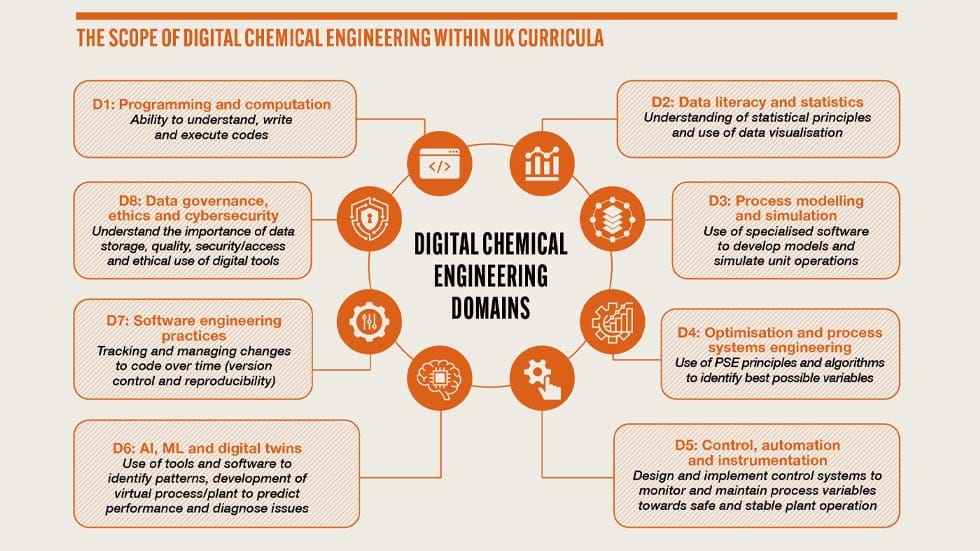
For those of us in academia and industrial leadership, this dictates a major shift in how we train the next generation of engineers. As we develop digital chemical engineering3 and integrate more data science and AI tools into the chemical engineering curriculum, we must ensure they do not displace the foundational science and engineering subjects that build professional intuition. Here, our challenge is no longer just teaching students how to use digital tools, but
The premium has permanently shifted from computation to evaluation
training students to govern the tools. We must embed digitalisation literacy alongside engineering judgement, ethics, process safety and rigorous peer-review practices.
The future of chemical engineering will undoubtedly be powered by AI. But if ESCAPE36 taught us anything, it is that the ultimate safety, sustainability and brilliance of our discipline will never belong to the machine. It will always rely on human expertise supervising it.
Recent Editions
Catch up on the latest news, views and jobs from The Chemical Engineer. Below are the four latest issues. View a wider selection of the archive from within the Magazine section of this site.