Mud, Mud, Glorious Mud Part 2: Different Clays and Different Ways
Martin Pitt continues the story of how clay made modern civilisation
KAOLINITE Al2Si2O5(OH)4 is a common constituent of brick and pottery clays but some deposits contain higher amounts and a low concentration of iron, giving a white or yellow clay called kaolin or china clay. It is named after Kao-ling, a hill in China from which samples were sent in 1712 by French Jesuit priest François Xavier d’Entrecolles (1664–1741). It is the main ingredient in porcelain which the Chinese developed about 700 CE by firing at very high temperatures up to 1,400°C. This creates a composite of glass containing needles of aluminosilicate crystals called mullite, which gives it a toughness like glass fibres in resin and a translucent quality which was greatly admired.
In 1748, Anglo-Irish artist Thomas Frye (1710–1762) produced “English porcelain” using kaolin from Virginia and bone ash fired at 1,200°C. The same year, English apothecary William Cookworthy (1705–1780) discovered some suitable clay in Cornwall, eventually finding the huge resource near St Austell which is still in production today. By 1910, Cornwall was producing half the world’s china clay. This was the basis for fine bone china such as Wedgewood, Royal Doulton and Spode, a major international export success. China now produces most of it.
Kaolinite clays are used for sanitary ware such as sinks and toilets as the ceramic has very little water absorption and is resistant to chemicals. These factors also make it useful for chemical process equipment. Kaolin is a common constituent of high temperature ceramic items.
The other major use is as a filler, whitener and smoothing agent in paper. It is also used for these purposes in many other materials, including rubber, toothpaste, cosmetics and pharmaceuticals. Purification is largely done as a water slurry with a range of physical and chemical processes. Removal of iron oxide is particularly important for whiteness. However, the waste material is itself fairly white so the huge piles from over 200 years became known as the Cornish Alps and the St Austell River was known as the white river. The advent of the steam engine produced powerful pumps enabling jets of water to be used to erode soft rock, known as hydraulic mining. This is used for clay in Cornwall and elsewhere. Hydraulic mining has caused significant environmental damage, particularly to water supplies and waterways, though Cornwall now operates more responsibly. Current world production is about 44m t and increasing, with about 9 t of waste per tonne of kaolin.

Quartz and Feldspar
These are silicate minerals, not clays, but often found within clay deposits. Quartz is silica SiO2, the primary component of sand, and is also found as crystals. Feldspar is the name for a variety of aluminosilicates such as KAlSi3O8 which crystallise out of volcanic lava and is the commonest rock on the surface of the Earth. They may contain Ba, Ca and Na as well. It is the weathering of feldspars which produces particles of clay.
Kaolinite clays are used for sanitary ware as the ceramic has very little water absorption and is resistant to chemicals
They may be added to clays as compatible minerals to improve workability, strength and economics.
Marl
This is a hard mixture of clay and limestone, which has been used as a soil improver from Egyptian times but particularly following the British Agricultural Revolution. It acts as a slow release of alkali for acid soils, contributing Ca and Mg. The swelling and shrinking of the clay with soaking and drying improves the crumb structure. Powdered and mixed with more plastic clay it gives strong fired bricks. Etruria marl in Staffordshire and the West Midlands was formed in the Carboniferous era and is a substantial source of red bricks in England. The lower portion of the cliffs of Dover is marl.
Fuller's earth
A Roman laundryman was called a fullo. He didn’t have soap, so trampled on clothes or beat them with a paddle in stale urine and with a special kind of clay. In English he was called a fuller and the clay was fuller’s earth.
Long before the Romans, the banks of the Nile included this clay which removed grease from wool fleeces or clothes. The clay contains two sheets of silica for every one of alumina, a structure known as montmorillonite from Montmorillon in France where it was first identified. It also contains calcium ions. Unlike kaolinite, it swells in water and has ion-exchange properties.

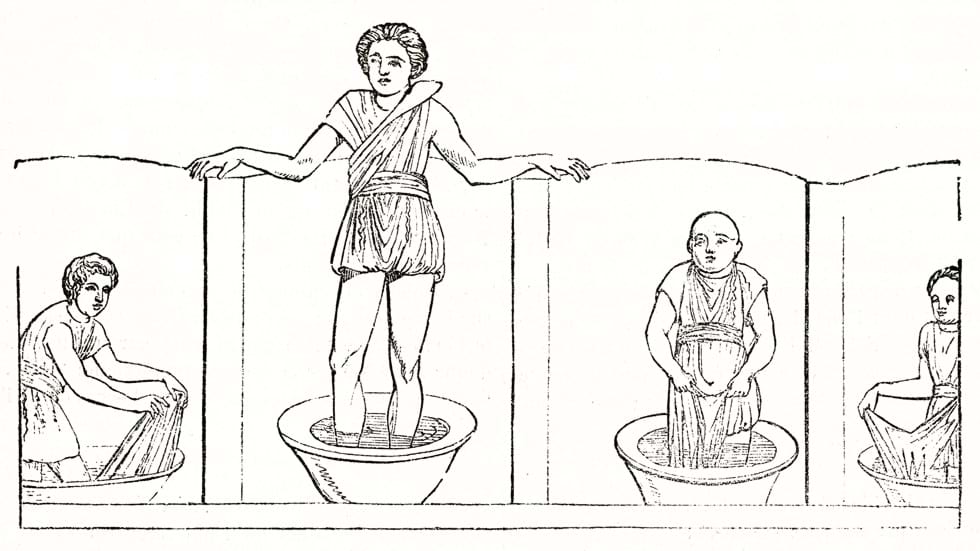
The clay was trampled, beaten, or rubbed on a washboard into fleeces or cloth to remove dirt in the form of colloids with the polymer attaching to the grease, and the ionic parts attaching to water. Suitable clays were found elsewhere around the Mediterranean, but not to any great extent around the Tigris and Euphrates, so the Mesopotamians had to discover soapy plants and minerals (see TCE 1,008 How Soap was Born). In Egypt it became sufficiently industrialised for lanolin to be extracted from the used clay. It was also used to clean hair and as part of dyeing, removing traces of chemicals before the next stage, and before the final rinse. Fulling was a skilled and arduous job which also treated cloth physically to give a smooth tight finish.
The clay was in extensive use in the Classical World and the Middle Ages. In the 13th century a degree of automation appeared in France with water-powered fulling mills for textile production, soon taken up in England, later elsewhere. Leonardo da Vinci designed one and steam-powered ones came later. The washed, dried and ground clay became an important item of commerce, with transport costs affecting the location and type of cloth industries. Fuller’s earth became a major traded commodity, with transport costs shaping the textile industry. As the price of soap fell, it took over from clay for regular cleaning, but fulling was still considered essential for finishing dyed cloth to give a smooth finish and reduce bleeding. In both world wars, fuller’s earth was used to save soap.
Its cleaning properties led it to be given as a medicine from ancient times and may have actually worked, unlike many substances prescribed. The combination of ion exchange and adsorptive capacity means it has been recommended for treatment of poisons. English polymath Sir Isaac Newton (1642–1727) carried out thermogravimetric analysis to measure its capacity for various metals and compounds. It is used today in deodorising cat litter because of this property. In World War One, French troops suffered less from dysentery than British in the Near East, because their medical officers ordered fuller’s earth to be mixed in with some food.
Roman concrete hidden self-healing trick
In 2023, the Materials department of MIT discovered that white particles in Roman concrete – previously thought to indicate poor mixing – appeared to be deliberate additions of coarse quicklime granules to the pozzolan mix. These CaO particles became coated with Ca(OH)2 and CaCO3 from the water and air before being sealed in the matrix, with the heat released accelerating setting.
When cracks later formed and water entered, the remaining CaO reacted to form the same solid products, effectively sealing the cracks. Laboratory tests using mixtures of ordinary Portland cement and coal ash confirmed this self-healing mechanism. The discovery could inform modern concrete formulations with enhanced durability and self-repair capability.
It is used for decolorising natural oils (glycerides), optimally with 5% water content providing a hydration layer for transfer to take place. However, for mineral oils (non-polar) completely dry is best. Even better is acid-treated clay. The powder is used as a form of dry cleaning, notably for leather.
In 1927, French motoring enthusiast Eugene Houdry (1892–1962) was looking for a catalyst to convert coal oil into gasoline. He succeeded with fuller’s earth. This started a revolution in the oil industry. The process and catalyst have been improved, but this was the historic start. Clays are used alone or treated as catalysts or catalyst supports in many chemical processes.
Bentonite
Bentonite is sodium montmorillonite, like fuller’s earth with a different ion. It was used wet as a lubricant for wagon wheels by American pioneers. In 1900, during the drilling of what was to become the famous Spindletop oil well, there was excessive loss of water being used as a lubricant. To counter this, American oil pioneer Captain Anthony F Lucas (1855–1921) got some cattle to trample in the pond holding the water, converting it to mud which sealed the walls. In 1901, based on this and his water drilling experience, he made a thick suspension with a bentonite clay for the next hole which was spectacularly successful.
It was patented as a drilling fluid additive in 1929 and marketed under the name Bentonite, from Fort Benton in Wyoming, near where it was mined. When mixed with water, it can swell up to a gel 15 times its volume, whereas the calcium one only doubles in volume. This swelling helps to seal walls, and it is used in many other civil engineering applications such as lining ponds or waste sites. A lower (cheaper) concentration than other clays can be used to give a viscous gel which carries drill cuttings up to the surface, and its shear-thinning characteristic means that it has effectively lower viscosity when being pumped down the drill pipe. Different deposits can have varying amounts of Na and Ca. Treatment with Na2CO3 can replace some of the Ca with Na, known as activated bentonite.
It can be used to make paint non-drip, to make mud for bricks more plastic, to thicken and stabilise foods and pharmaceuticals, to aid the workability of cement products and many specialist applications. Currently around 21m t a year are sold. The US is the largest producer, followed by India and China.
In 1939 Britain’s first commercial natural gas fields opened and the first of several oilfields were drilled. When World War Two began, the importation of bentonite from the US was more
Eugene Houdry was looking for a catalyst to convert coal oil into gasoline. He succeeded with fuller’s earth which started a revolution
Research showed that British fuller’s earth could be converted to synthetic bentonite by double decomposition with sodium carbonate. This required very careful control of moisture in a rotary louvre dryer for a product called Fulbent. In 1963, another company produced Berkbent, just in time for the licensing of North Sea Gas.
It turns out that this reaction had been performed by the Ancient Greeks. In 405 BCE the playwright Aristophanes (446–386 BCE) described a cleaning agent made by combining fuller’s earth with soda.


Concrete
With this modern building material, we are back to the mud hut. Instead of piling up stones or bricks we have a plastic material which we can shape in moulds. We can even make bricks from it. Instead of twigs and branches we give it steel or possibly other materials such as carbon fibre or reprocessed waste plastic. And instead of clay, we use – well, processed clay. More concrete is produced than any other synthetic substance. And it is made from clay. Going back a bit, the Romans mixed lime Ca(OH)2 and sand with some volcanic ash from the region of Pozzuoli close to Mount Vesuvius. This is now called pozzolan. In the presence of water, they slowly react to give a durable solid, usually mixed with sand and stones, which they called caementum. How durable? More than 2,000 years so far. As it sets underwater, it was used for harbours from about 200 BCE.
The transport costs from the volcano made this concrete too expensive for 19th century industrial Britain, but English bricklayer Joseph Aspdin (1778–1855) made his own volcano and patented it in 1824, using two cheap and readily available materials, limestone and clay. In a furnace at 1,450°C, limestone CaCO3 decomposed to CaO while clay was dehydrated as in the manufacture of bricks, the two reacting together to give lumps of a very hard material, called clinker, which was ground to powder. He called the powder Portland cement, by comparison with white smooth Portland stone. Mixed with limited water, further reactions changed it into a solid the same day, rather than months. In fact gypsum (CaSO4·2H2O) is usually added to slow it down so that it remains workable. Mixed with sand it becomes mortar. With aggregate (stones) it is concrete. This was the beginning of a vast industry, now producing 30bn t of concrete a year, using what is now known as Ordinary Portland Cement (OPC) as well as variations. Marl, providing both clay and limestone, can be used in appropriate mixtures for OPC synthesis.
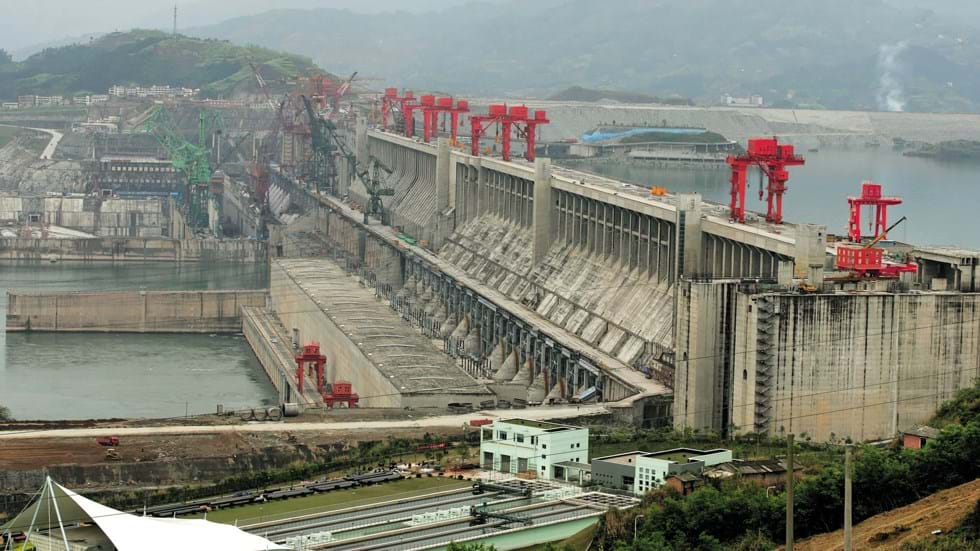
Like coal, the very success of OPC has had profound effects on the environment. The conversion of CaCO3 to CaO naturally releases CO2 (though some can be absorbed as the concrete matures). In addition, lime burning and clay dehydration also have a large energy demand, which almost always comes from fossil fuel in the furnace, accounting for 70% of the CO2 released. Crushing limestone, clay and clinker is also energy intensive. One tonne of cement releases about 900 kg of CO2. Typically clay minerals (clay, shale, slate) account for 20% of cement. Aggregates in concrete commonly contain substantial clay minerals.
One method of reducing this environmental impact is to include the pozzolanic process as part of a concrete mix. These formulations are initially less strong but over years develop a higher strength and can have an increased lifetime. Countries such as Italy with access to volcanic ash already do this. However, in the 19th century it was realised that coal ash is mainly burnt clay, so waste piles were mined for it. Blast furnace slag can also be ground up for a similar purpose, though in both cases the material is variable and care may need to be taken regarding its effect on the concrete setting and properties. These are, however, limited resources, and most are already being used for this purpose in the UK.

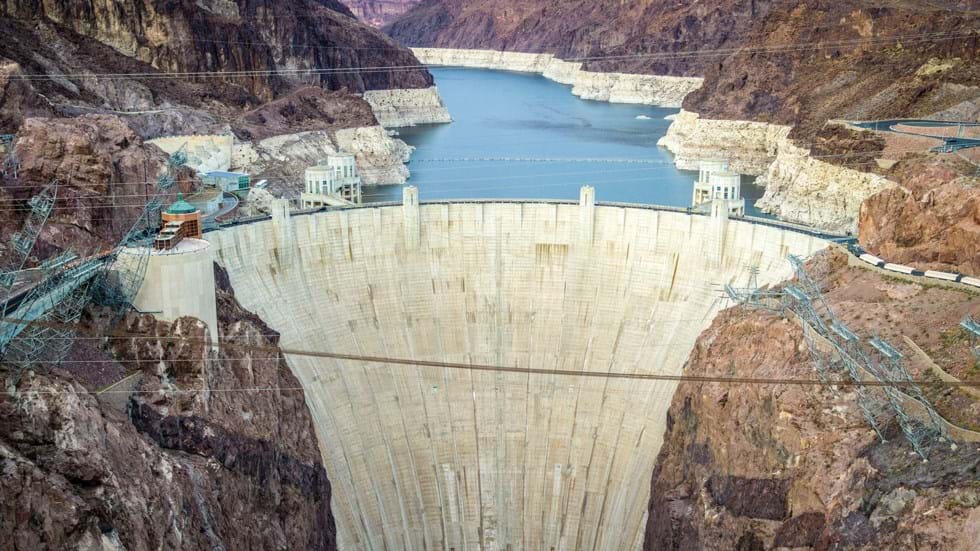
Waste from the demolition of concrete structures has usually been put into landfill but efforts are now being made to crush it for use as aggregate in new concrete. Clay bricks can also be used as aggregate. Research suggests that waste from brickmaking or other clay products (which is more consistent) can be calcined at a lower temperature than OPC, making a lower carbon footprint pozzolan. A range of methods are now being tried to create lower energy and CO2 concrete. A major strand is increased use of clay minerals. Limestone Calcined Clay Cement (LC3) adds unburnt limestone and calcined clay (containing metakaolin) to OPC powder with water. A common mixture is 50% OPC, 30% calcined clay, 15% limestone, 5% gypsum. The water releases soluble compounds from the calcined clay which react with the limestone to give calcium aluminate and silicate structures bonding particles together. The calcined clay can come from lower quality (cheaper, more available) than that used for OPC. Some 30% reduction in CO2 is claimed. In essence, more clay is used – a modern world quite literally built on mud.
Martin Pitt CEng FIChemE is a regular contributor. Read other articles in his history series: https://www.thechemicalengineer.com/tags/chemicalengineering-history
Recent Editions
Catch up on the latest news, views and jobs from The Chemical Engineer. Below are the four latest issues. View a wider selection of the archive from within the Magazine section of this site.