Mud, Mud, Glorious Mud Part 1: Mud Huts to Modern Days

Martin Pitt describes how clay transformed human history
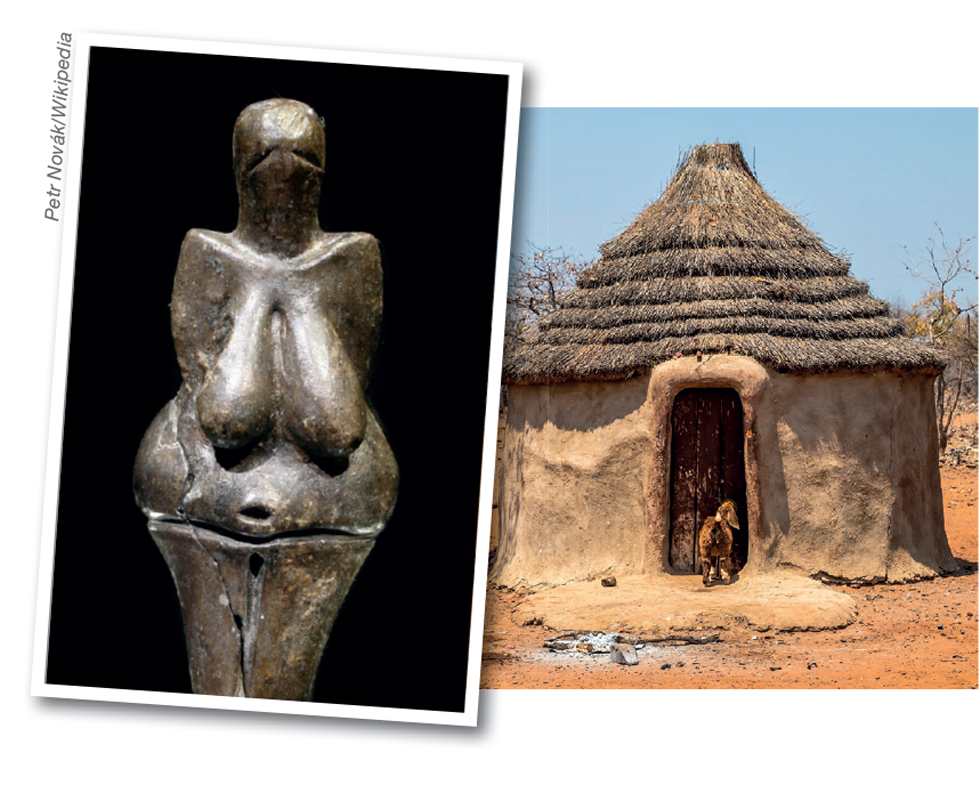
MODERN Iraq was formerly called Mesopotamia, meaning between two rivers (Tigris and Euphrates), and this is where some of the first agricultural settlements arose in around 10,000 BCE. They had plenty of mud. The settlers used river clay over branches to make circular mud huts with thatched roofs, the main style of dwelling in much of human history, including Britain, until the Middle Ages. Today I live in a mud hut, though it is rectangular and the mud has been baked into bricks, transforming it into a hard, durable solid - a chemical reaction that was critical to the first civilisations and remains essential today.
Clay chemistry
Clays were formed by the weathering of silicate rocks and sedimentation. They are fundamentally tiny particles (<2 μm) of inorganic polymers of aluminium, silica, oxygen and hydrogen such as kaolinite Al2Si2O5(OH)4. Some clays have ions (Na, Ca, Mg, Fe) which change the properties. Kaolinite has equal numbers of silica and alumina sheets. The hydroxide groups link sheets of alumina and silica together by hydrogen bonds. There is also a layer of water bound to the outer surface of each particle by the same bonds. This allows the particles to slide over each other, given the slippery plastic character. When dried in the sun, free water is lost and the particles adhere to one another, forming a solid. Owing to its dense nature, this solid is reasonably water-resistant but it can become plastic again under prolonged or intense wet conditions. Therefore, the simplest mud huts are remade every year or two.
If, however, the clay is heated above 400°C then the hydroxide groups dehydrate, forming oxygen bonds between the polymer sheets and between particles to give a permanent solid. This chemical transformation made the greatest impact on human history since the use of fire for cooking.
Early humans probably discovered this transformation accidentally around a campfire and used it for artistic purposes. The earliest known ceramic objects are figures of animals and a woman known as the Venus of Dolní Věstonice, about 30,000 years old, found in what is now Czech Republic.
Pottery
The invention of pottery (ie ceramic vessels) created modern human society. It was probably discovered independently in different parts of the world, with the earliest known examples dating to approximately 20,000 years ago in China and 16,500 years ago in Japan. It was once assumed that pottery emerged from sedentary agricultural societies but these early examples were produced by hunter-gatherers living in Ice Age conditions. However, in general, pottery is found in permanent settlements near clay sources, pottery is found in permanent settlements.
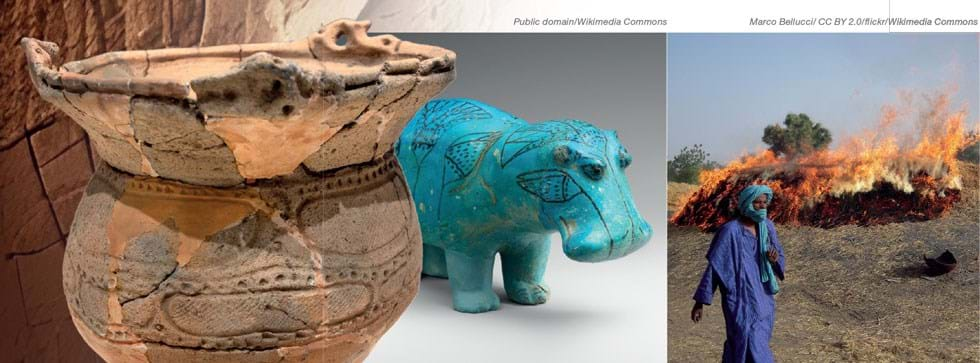
A pot could be used for transport and vermin-proof storage of liquids and solids such as seeds and flour. It also allowed mixing of foodstuffs, cooking in water, baking and fermentation to make beer. Early ovens were a flat stone covered with a pot. The potter was one of the first specialist trades. The selection of the right mud, its treatment, shaping and firing were all rare arts. Bits of grit, plant material or cavities could cause a pot to fail, as could careless firing. These experts did not hunt, gather or farm but relied on food from others while developing an industry of traded objects that became highly competitive, with varied styles and decorations. Archaeologists can identify many peoples and dates from the millions of pottery shards discovered. Pots were generally baked in a fire-pit covered with turf, as they still are in some places.
About 4,000 BCE the first wheel on an axle was invented in Sumer, southeast Iraq - the potter's wheel, which rotated slowly as coils of clay were built up to form vessels (in about 3,500 BCE the first wheeled vehicles were developed). Then in about 3,000 BCE the Egyptians invented the fast potter's wheel, with a flywheel to allow the modern technique of forming a lump into a cylinder or bowl.
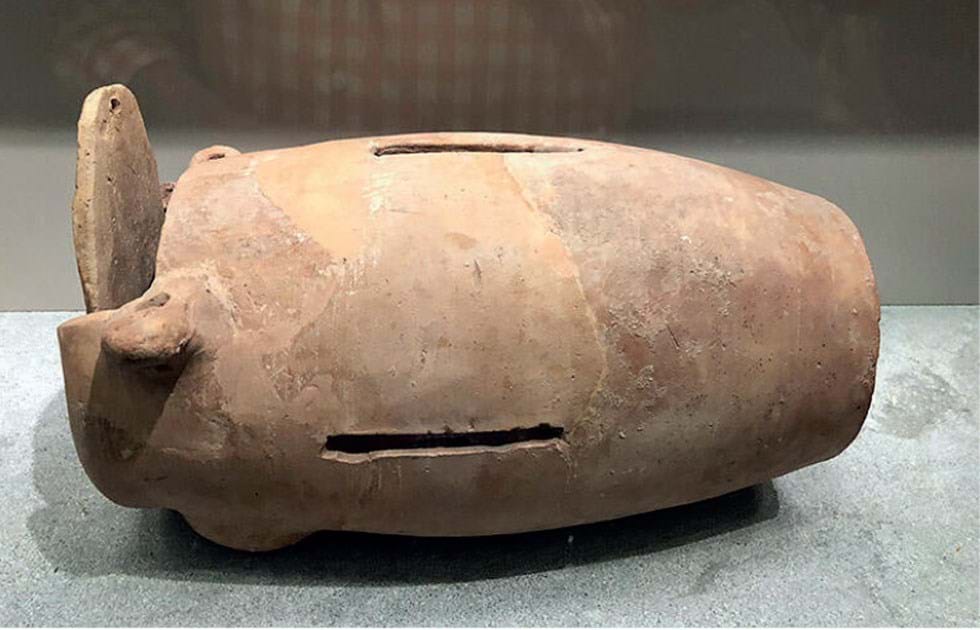
Pottery was the first thermoplastic - something which could be easily made into any shape then irreversibly converted by heat into a rigid shape. As well as containers and art it could be made into functional items dependent only on the ingenuity of the maker. A pottery mousetrap dating to around 2,000 BCE has been found at the site of Harappa, in present-day Pakistan.
From about 4,000 BCE Egyptians began melting coloured glass over objects for decorative rather than functional reasons.
Pottery was the first thermoplastic - something which could be easily made into any shape then irreversibly converted by heat to a rigid shape
In about 1500 BCE Chinese potters noticed that ash falling on pots in the furnace affected the surface and started painting it on deliberately as a slurry. The alkali reacted with silica in the clay to form a glassy coating of sodium silicate. The glaze waterproofed and protected the surface. Many other minerals have been used at different times and places to form a glaze. In about 1400 in Germany, it was discovered that ordinary salt would do, and salt glaze was extensively used in Europe until recently for tiles and drains. It is no longer used due to the chlorine fumes produced.
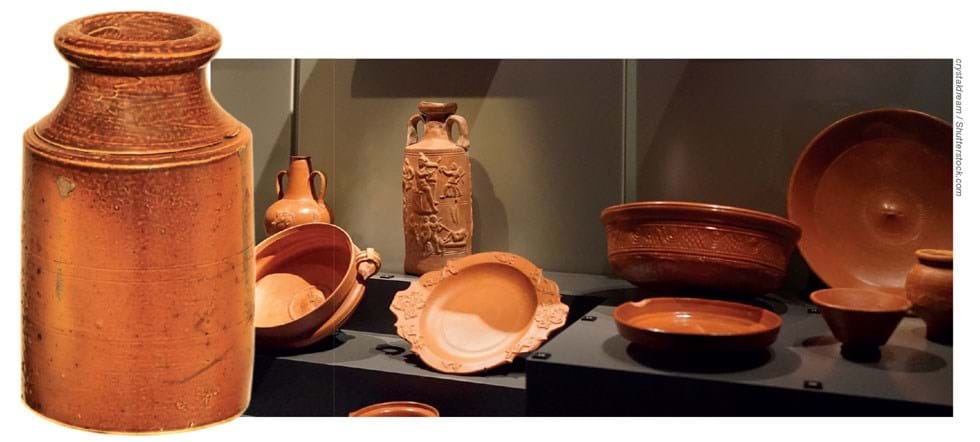
It was the Romans (who else?) who converted an Egyptian craft skill to mass production of standardised utilitarian ware, with division of labour, from about 100 BCE onwards. Earlier potters worked alone, doing everything from digging the clay to firing the pots, whereas Romans had groups for every stage, with clay preparation and blending according to the type of clay. Their kilns had a self-supporting clay dome and a carefully controlled updraft through bars supporting the pottery, operating at about 1,000oC. Red glazed terra sigillata (meaning moulded earth) tableware with the manufacturer's mark moulded on the bottom was common around the Mediterranean for six centuries.
Bricks
A different style of mud hut emerged around 8,000 BCE, using clay shaped into blocks – often mixed with binding agents such as straw or dung – and dried in the sun. Wooden moulds helped standardise and speed up production. Mudbrick societies learned how to mix local clays with other minerals to give stronger bricks as part of the development of the technology. These can be used alone to build walls, supporting a thatched roof. They were later used to build other structures such as the defensive walls of the city of Jericho. The Aztec pyramids from the 15th century are still standing. Egyptians used the word adobe for mud bricks around 2,000 BCE, and both the word and technology are still extensively used for long-term construction in many dry parts of the world.
It was in about 5,000 BCE that fired bricks began to be used in Mesopotamia, enabling stronger and more durable constructions. Luckily, much of the clay in Mesopotamia contained lime. While pure kaolin can bind with itself, at higher temperatures it becomes reactive to lime (natural or added) forming additional calcium bridges. In about 3,200 BCE clay tablets containing some of the earliest writings were preserved for posterity by being fired. According to these accounts, the god Enlil formed the first man from mud, shaping it in an elaborate brick mould before leaving it to bake in the sun. Contracts were written in duplicate and signed with fingerprints on tablets scored down the middle. The scribe would fire the tablet then break it in half in the presence of the signatories, giving unalterable records.
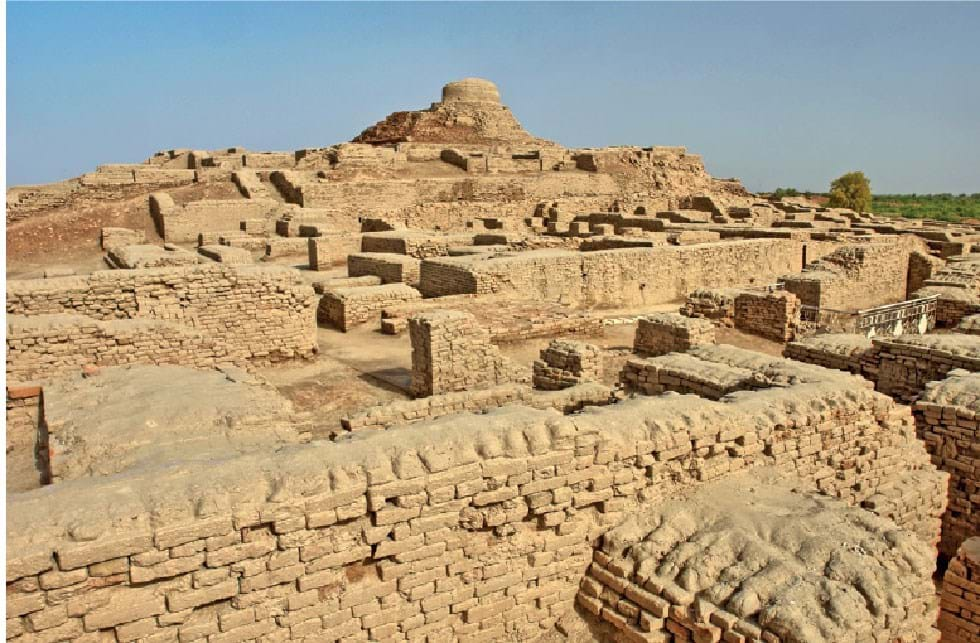
Egypt made little use of fired bricks until the Roman occupation. In the Indus Valley civilisation (in what is now Pakistan) around 2,500 BCE, the city of Mohenjo-daro used fired brick on a scale far exceeding that of any other civilisation, not for monuments to rulers or gods, but for civic engineering. Brick houses were arranged in an orderly grid and rose up to three storeys, with some including bathrooms. The city featured a massive public bath (12 × 7 × 2.4 m) constructed from closely fitted bricks sealed with bitumen. Extensive drains led to brick-lined sewers and circular brick-lined wells were also invented here. Clay kilns were used to make bricks more efficiently and with greater control, using less fuel than traditional fire-pits. They were also more efficient for pottery. Bricks enabled larger furnaces, ovens and ceramic-lined containers to be constructed, thus enabling metallurgy and glassmaking to develop to modern scale. In the British Industrial Revolution, certain clays suitable for higher temperature service were known as fireclay. Conveniently, they were often found below coal seams, their structure having been affected by the plants which formed the coal. Once the coal had been mined out, valuable clay could be extracted via the same mineshafts. Ordinary house bricks were generally made from surface-quarried clay.
The same industrial expansion encouraged the development of "engineering bricks" - harder, stronger and with lower water absorption. The low-oxygen, high-temperature firing caused the red iron to reduce to a blue colour. Careful selection and purification of the clay was essential. Slate, a clay mineral, was often included in the mixture.
In commissioning any high temperature chemical engineering process today, the drying out of ceramics and slow expansion as they are brought to temperature is a critical stage which must not be hurried.
Shale and slate
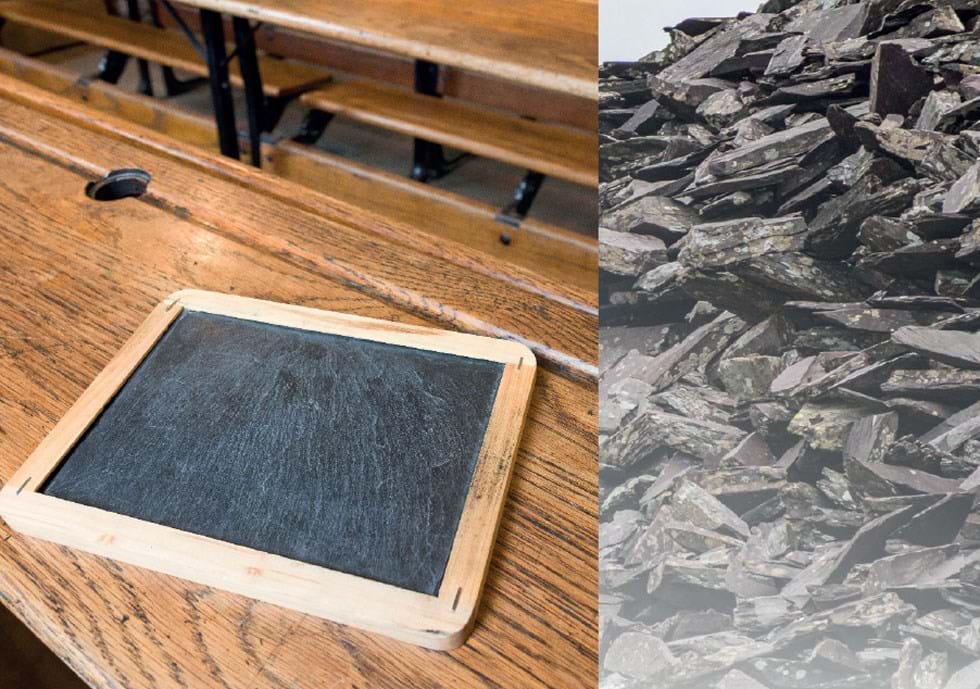
Sedimentary beds of clay and quartz mud can form mudstone. Geological pressure compresses this into shale, a soft, friable rock which is the commonest. The clay turns into flakes which are oriented so that the rock easily breaks into splinters.
Further pressure and heat can cause the clay to metamorphose into mica, with a typical formula KAl2(AlSi3O10)(OH)2, giving slate, a hard water-resistant rock which can be easily split upon a particular pane.
From about 6,000 BCE neolithic hunters made knives and spear tips from slate. Engraved slate plaques have been found dating from 3,200 in Iberia with what may be the earliest form of proto-writing in Europe.
Where it was the local rock, it was used for Stone Age walls but it was the Romans (again) who pioneered its use as roofing material and flooring across its empire, notably in Britain and Iberia. When they left, the European natives went back to thatch, although slate roofs were revived for churches, particularly in the 12th century. In India, slate roofing dates to the tenth century. Industrialisation from the 18th century made slate easier to extract, and quarrying began in the US in 1743. Today, the world’s leading exporters of slate are India, France, Spain and China.
Pottery was the first thermoplastic – something which could be easily made into any shape then irreversibly converted by heat to a rigid shape
In the 1800s slate tablets were common in British schools for children to write on with chalk, the practice having started in Wales. They were the size of roofing tiles, ranging from 30 × 51 cm to 36 × 61 cm and had a wooden frame. The teacher’s larger tablet, known as a blackboard, was generally 137 cm high and as long as could be afforded. In 1845 Pennsylvania, two Welshmen recognised a suitable slate outcrop and set up a quarry. The town was named Slatington and in 1897 supplied 2m school slates a year to many countries.

In the 1830s, slate's natural flatness and dimensional stability led to its use in billiard tables. Its resistance to acids and insulating properties made it ideal for laboratory benchtops and electrical equipment. Slate roofing was withheld during both world wars to conserve it for electrical use but it is now increasingly popular as a natural material with a lifespan of around a century and a lower energy footprint than clay tiles.
Shale itself is not a structural material but can be used in foundations and as an aggregate. It is also used as an addition to clay for bricks and pottery. However, its main economic significance today is for fossil fuel. Organic material in mud under low-oxygen conditions can transform into a waxy substance called kerogen, but during slate formulation, it is generally expelled into the paces between mineral sheets. Shale with sufficient kerogen can be burned like coal. Estonia has been dependent on it but plans to phase out these power stations by 2035. Kerogen sometimes naturally converts further into petroleum or gas or can be distilled out. From about 3,000 BCE the tar has been used as an adhesive, waterproofing and for flaring arrows.
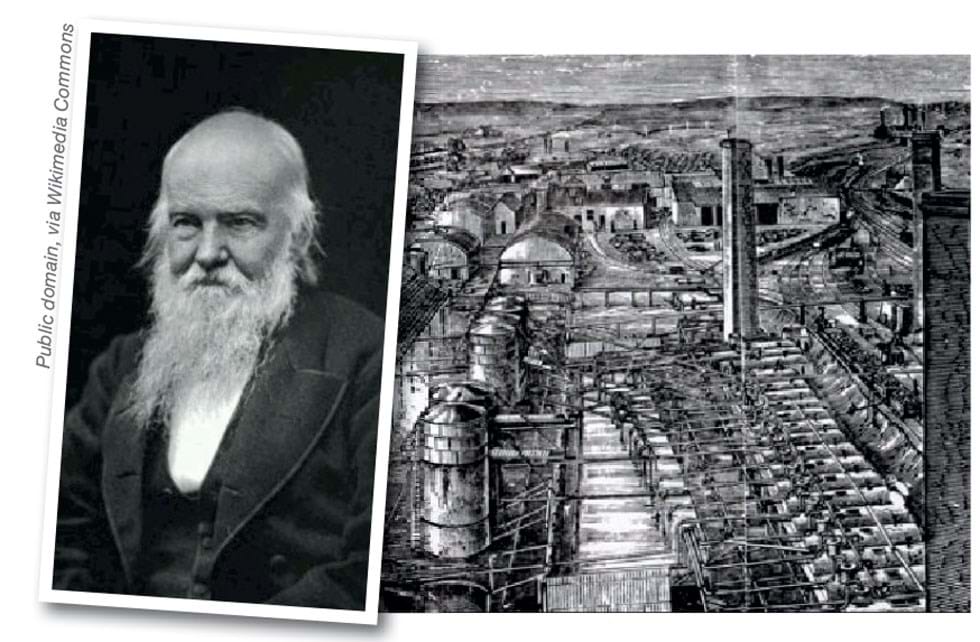
In 1694, a British patent was awarded for "a way to extract and make great quantities of pitch, tarr, and oyle out of a sort of stone", which we would now call oil shale, in a batch retort. The modern industry began in 1838 when multi-talented French inventor Alexander Selligue (1784-1845) mined oil shale and distilled it into lighting oil, later gas for lighting. Shale oil companies began in North America but soon went out of business following the drilling of petroleum reservoirs in 1859. However, in 1865, Scottish chemist James “Paraffin” Young (1811–1883) built a shale oil refinery, then the largest chemical works in Scotland. It operated until 1921.
With petroleum reservoirs depleted, from 1965 the development of “fracking” (fracturing deposits by pumping high pressure water and chemicals with sand as a proppant to hold cracks open) has greatly increased the yield from such deposits, though with environmental concerns.
In the next article I will deal with the chemical properties and uses of different clays.
Martin Pitt CEng FIChemE is a regular contributor. Read other articles in his history series: https://www.thechemicalengineer.com/tags/chemicalengineering-history
Recent Editions
Catch up on the latest news, views and jobs from The Chemical Engineer. Below are the four latest issues. View a wider selection of the archive from within the Magazine section of this site.